Paul Booth shaped dark art as it exists today by tattooing freestyle without stencils, while horror realism stays tighter to film sources and needs an artist who can handle portraiture accurately.
Black and grey holds more depth than color in this range, and pieces scale from small alchemical glyphs to full chest and arm coverage that takes 20 hours across multiple sessions.
Your choice turns on whether you want surreal composition that shifts with the body or screen-accurate characters that read immediately.
1. Horror Film Creepy Tattoos
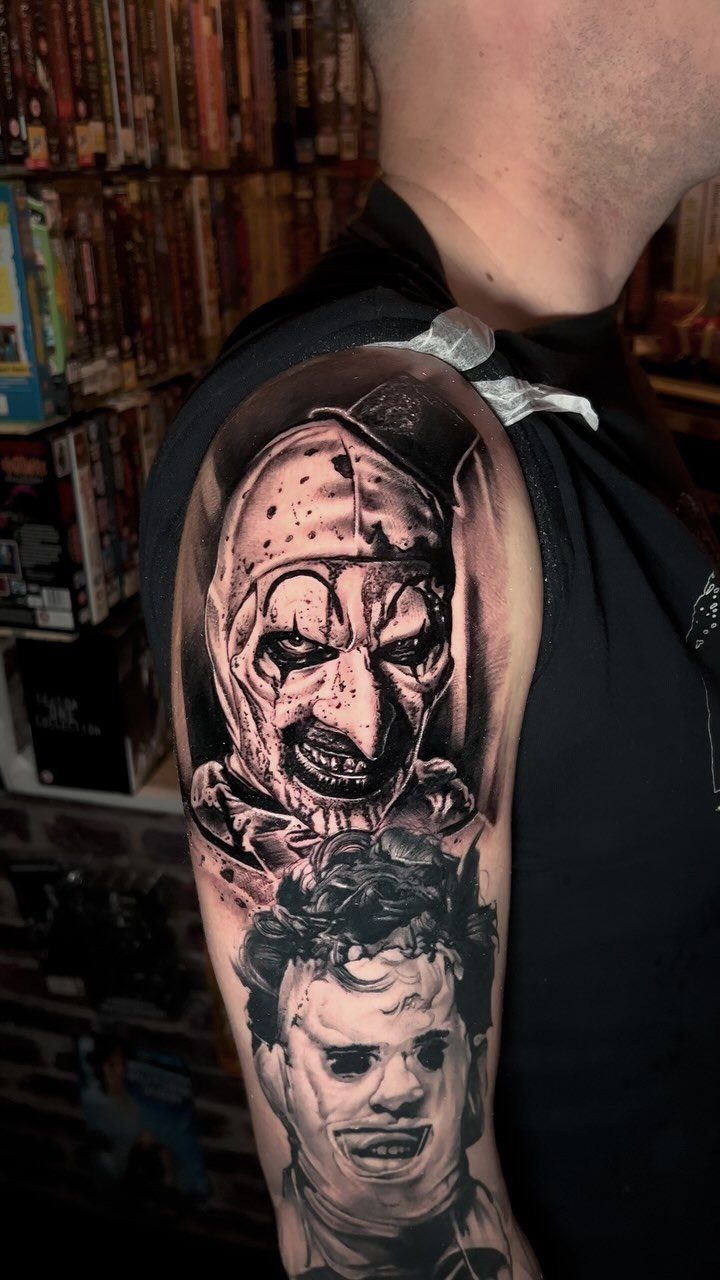
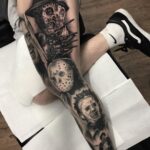
Horror film icons bring instant recognition and a tested kind of fear that prints well in black and grey.
Art the Clown and Michael Myers each carry their own texture: Art’s grin reads sharp even at a distance, Myers stays flat and featureless, which holds the threat longer.
Upper arm placement gives enough room for 2 characters without crowding, and the neutral background keeps attention on the faces. If you want a full sleeve later, this style scales easily into additional scenes or characters from the same films.
2. Dark Art Skulls Tattoos
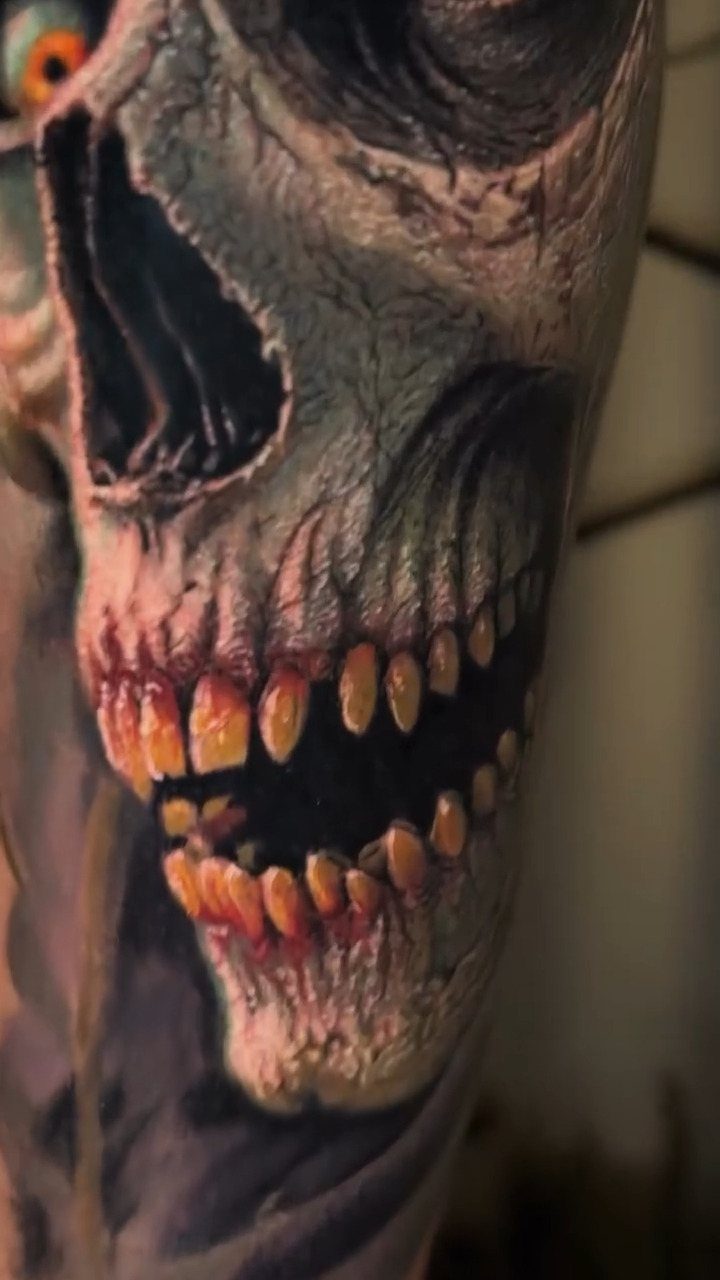
A decaying skull trades clean symmetry for texture that catches light differently as the piece heals. Yellowed teeth and cracked bone give dimension, and the detail holds up better over time than smooth linework alone.
This size works on a forearm, outer bicep or calf. Black and grey shading lets the artist push contrast in the eye sockets and jawline, which is where the creep factor actually lives.
3. Black and Grey Devilish Creatures Tattoos
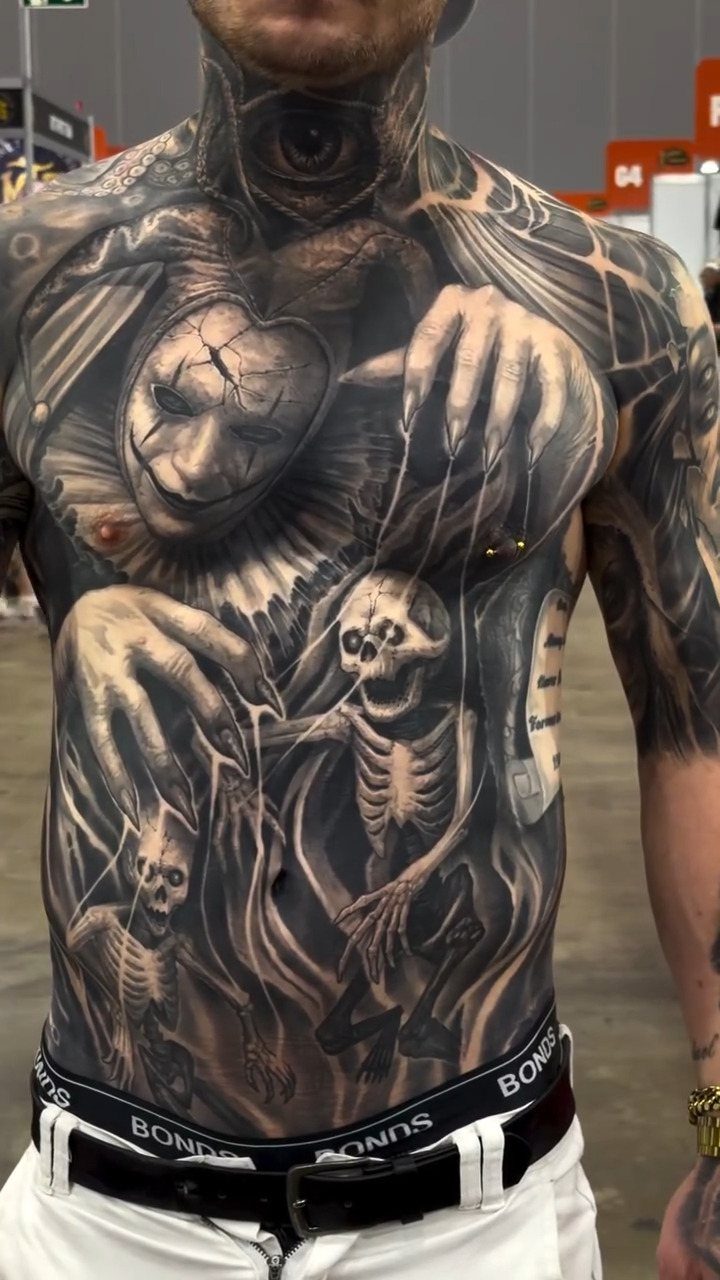
Covering the chest and arms with devilish creatures in black and grey turns the body into one continuous piece rather than separate images. Skeletons, masked figures and demons flow across muscle and bone, so the design shifts as you move.
This approach takes multiple sessions and benefits from an artist who can blend pieces without obvious borders.
Pain is higher on the ribs and collarbone, but the result reads as intentional coverage instead of collected singles. Budget for at least 20 hours total across several sittings.
4. Alchemical Symbols
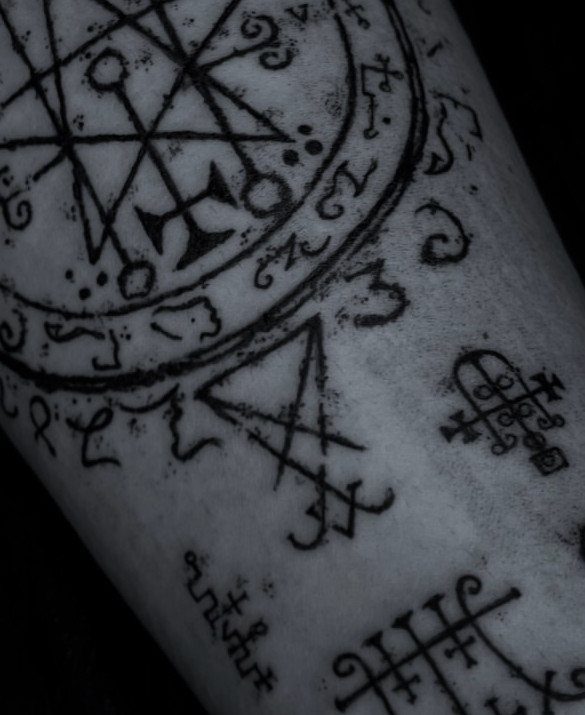
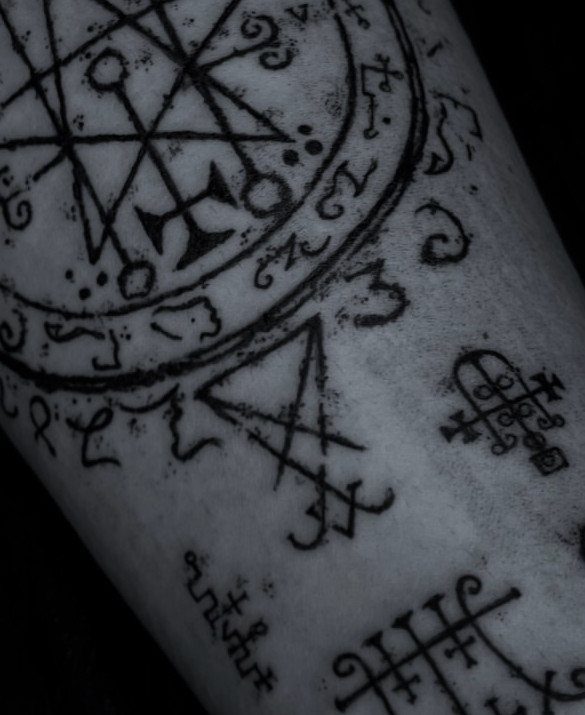
Alchemical symbols carry weight without readable imagery, which makes them unsettling in a different way than faces or creatures.
Circular sigils and geometric glyphs stay small and still hold detail, so they work as gap fillers or standalone pieces on the wrist, behind the ear or across the collarbone.
Black ink keeps the lines crisp, and the abstract shapes age well because there is no realism to fade. Each symbol historically references transformation, death or hidden knowledge, so the meaning stays layered even when the design stays minimal.
5. Creepy Clown Tattoos
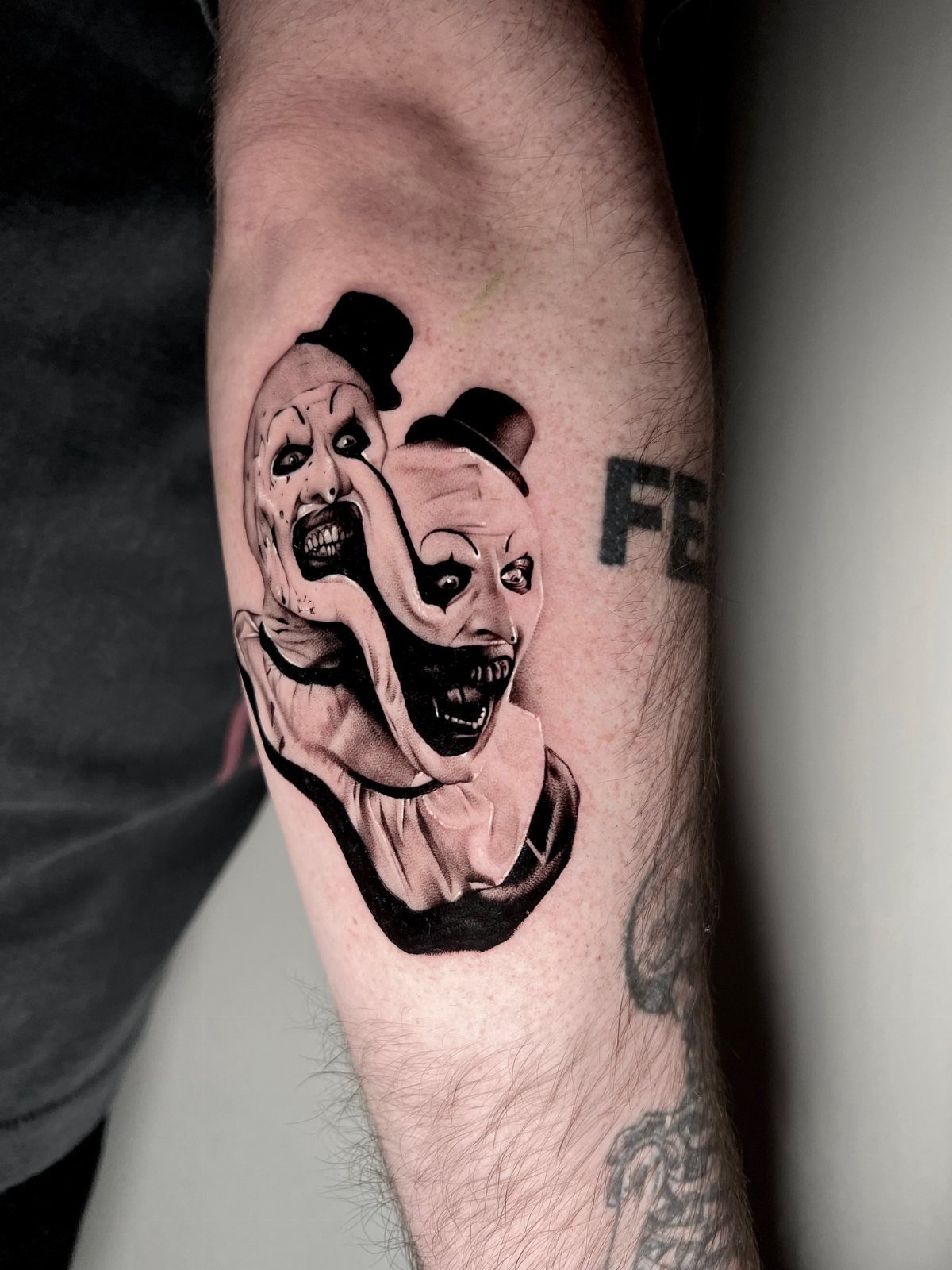
Two distorted clown faces with top hats and jagged teeth play off symmetry without matching exactly, which makes the piece harder to settle into.
Ruffled collars and sharp details print well on a forearm, where the natural taper of the arm lets one clown sit slightly higher than the other.
Black and gray keep the focus on expression rather than color, and the style ages cleanly because there is no fine linework to blur. Forearm placement means the tattoo is visible to you and easy to cover when needed.
Tattoo Artist Recommendations
Booth built the dark art style as it exists today.
He owned Last Rites in New York City until 2020 and tattooed freestyle directly onto skin without sketching an outline first. His client list included members of Slipknot, Slayer, Pantera and Sepultura, and Rolling Stone covered his work in 2002.
Paul Acker works in horror realism and focuses on film characters like Jason Voorhees and Michael Myers. His approach is different from Booth’s organic method: Acker stays tighter to the source material and uses portraiture techniques to capture recognizable faces.
Both artists bring serious depth to horror imagery, and their portfolios show exactly how each one approaches the genre.
Surreal, freehand work is where Booth’s approach reads best. If you prefer screen-accurate character work, look for someone who tattoos like Acker.
Tattoo Styles
Dark art uses high contrast and surreal composition, shaped by the body part it occupies. Most artists stick to black and grey, though some add color selectively.
Horror realism takes a different path: it reproduces film characters or specific scenes with tight detail and accurate proportions. This style needs an artist who can handle portraiture, since a face that is slightly off reads wrong immediately.
Fine artist Keisuke Aiso haunted people around the world with his truly terrifying Momo sculpture. And of course, plenty of tattooers create creepy (yet cool) tattoos for clients around the world every single day.
Cultural Influences
Horror films supply the clearest visual references for dark tattoos. HR Giger’s biomechanical work shows up often, especially in pieces that blend organic and industrial forms.
Heavy metal culture drives much of the demand. Paul Booth tattooed members of Slipknot, Mudvayne, Slayer, Pantera and Sepultura, and his work matches the album art and stage imagery those bands built their look around.
Devilish creatures, transvestite nuns and decapitated religious figures all appeared in his portfolio during that period.
Asian horror adds ghosts, demonic spirits and masks with supernatural power. Chicano fine line brings in the joker and female devil figures.