Style decides which skull tattoo design will still read clearly a decade out.
Sugar skulls need mid-forearm or thigh placement to pack in the pattern density that separates them from generic decorative skulls, while a traditional bowler-hatted skull holds up at any size because thick lines do the work.
Realistic skulls demand upper arm or thigh space or the shading compresses into mud as grey tones settle.
Pairing a skull with roses, anchors, butterflies, crowns, serpents or wings shifts the meaning from pure death imagery toward transformation, sailor tradition or memorial tribute, and adding one accessory or creature pulls the design into a specific mood without needing a full scene.
1. Sugar Skull Tattoo
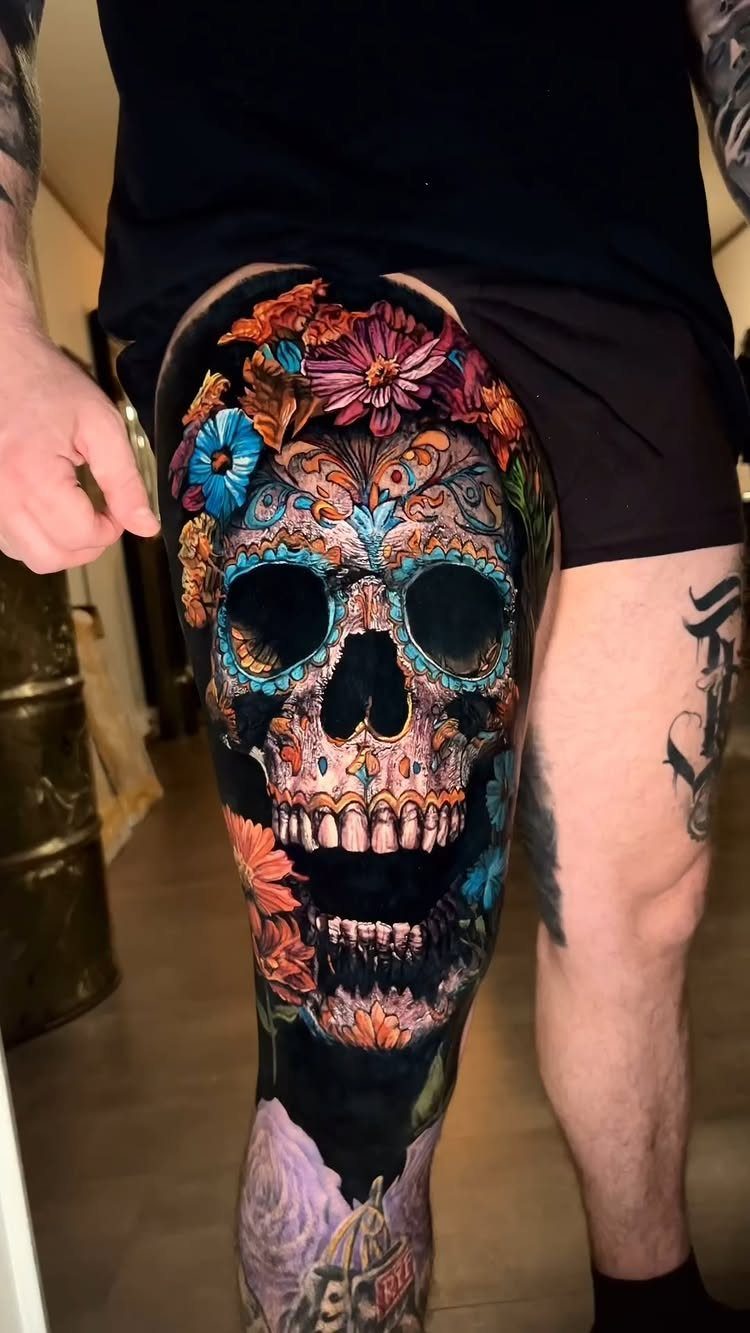
A skull dressed in the bright symmetry and floral detail of Día de los Muertos. Color is how this one lives: hot pinks, oranges, marigold yellows filling patterns across the forehead and cheekbones, petals winding through the eye sockets.
Scale helps.
A palm-sized version loses the pattern density that makes the design read as sugar skull rather than decorative skull. Most go mid-forearm, thigh or shoulder, where you can pack in the line detail without the shading blurring over time.
Blacks stay crisp longer than the bright fills, so expect the purples and reds to need a refresh to keep them electric a decade out.
2. Skull and Rose Tattoo
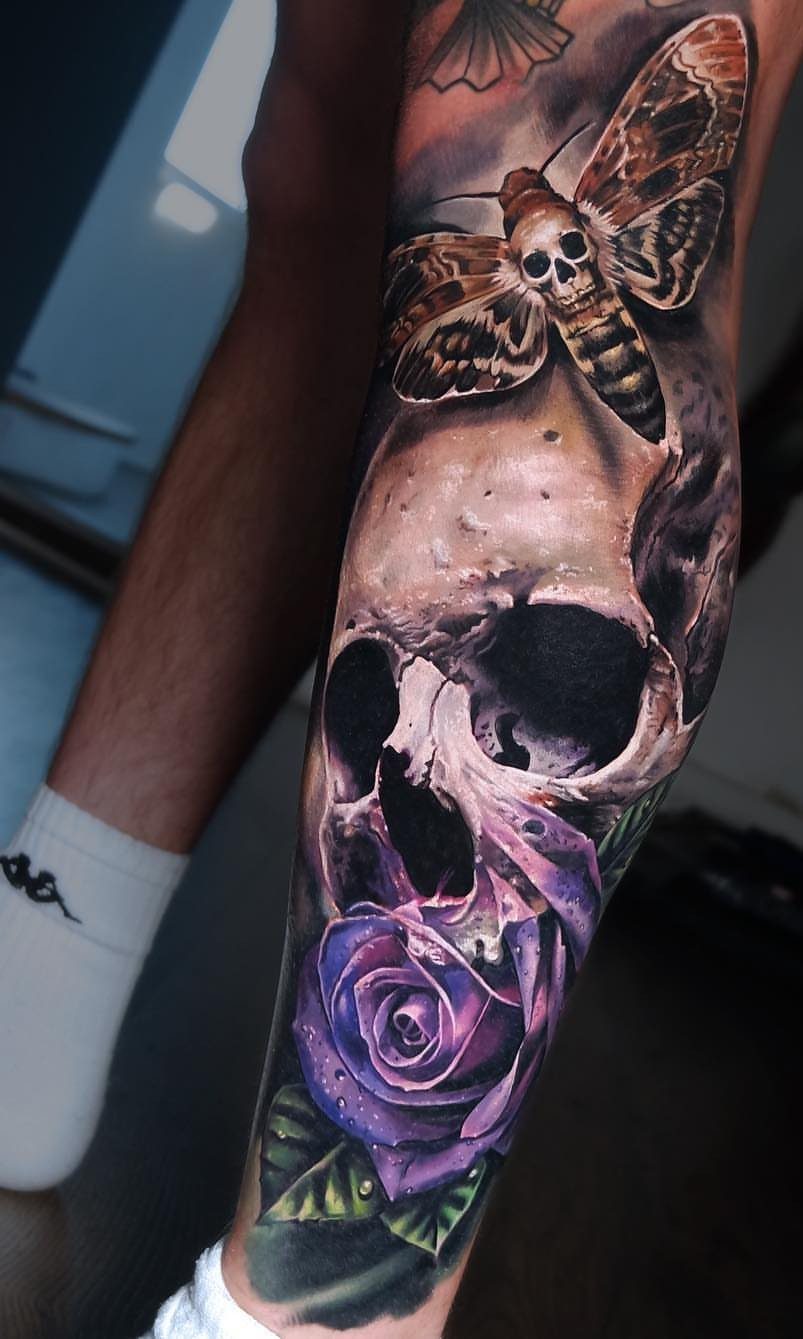
Beauty growing out of decay, or death framing beauty, depending which way you tilt it. The moth adds a third layer: transformation, short life, the skull pattern nature already printed on its back.
Purple rose keeps it moody without going full black-and-grey.
A red rose leans romantic, white leans memorial, but purple holds that gothic middle ground. Realism is the usual approach here, which means finding an artist who can render petal texture and bone structure without either one going soft.
Forearm or outer thigh gives you the vertical space to stack all 3 elements without cramming them.
3. Grim Tattoo
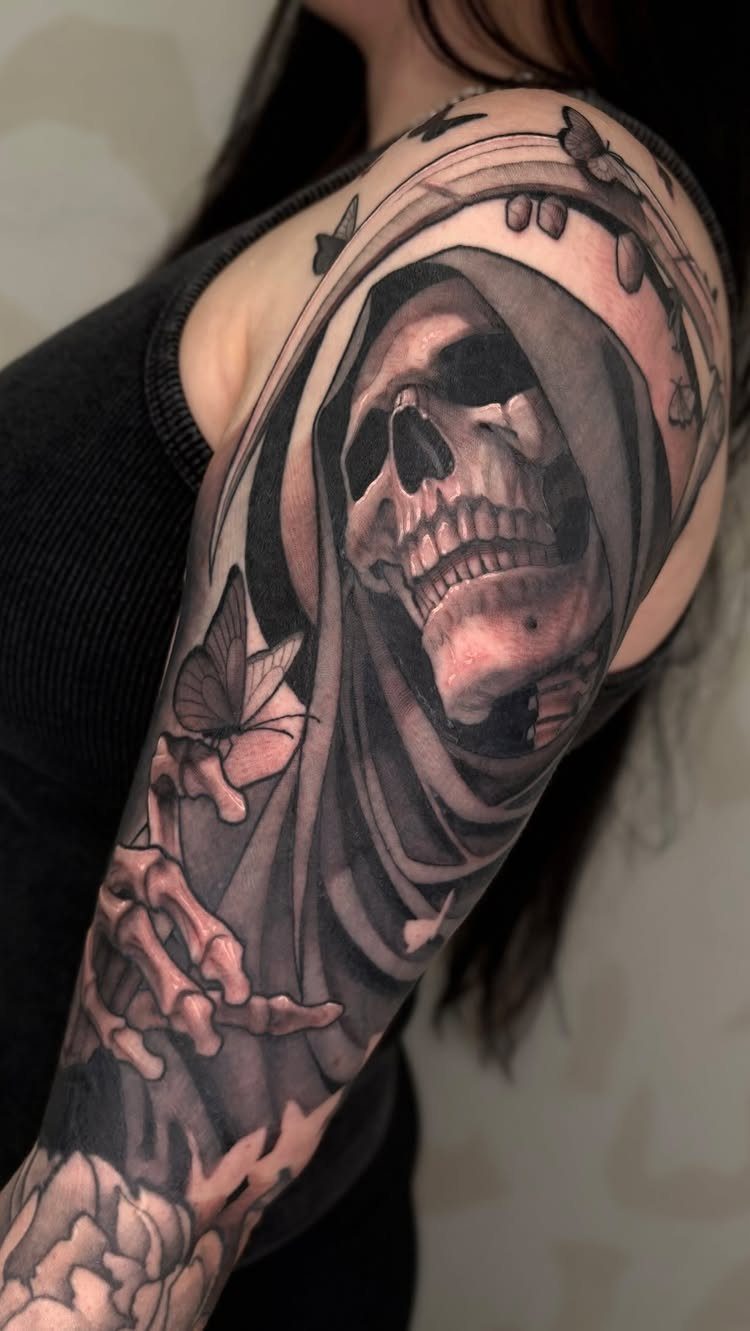
A hooded skull with one skeletal hand rising, butterflies lifting away from the shadows. The Grim Reaper stripped to bones, paired with the transformation butterflies represent, reads as mortality meeting rebirth.
Black and grey fits the subject better than color.
Adding color to the butterflies pulls focus, which works when they’re meant as the hopeful detail against the dark figure. Keeping them monochrome holds the whole piece in the same somber register.
Upper arm gives you room to frame the hood and hand without the composition feeling squeezed. Ribs work too for a larger, more private placement.
4. Serpent Skull Tattoo
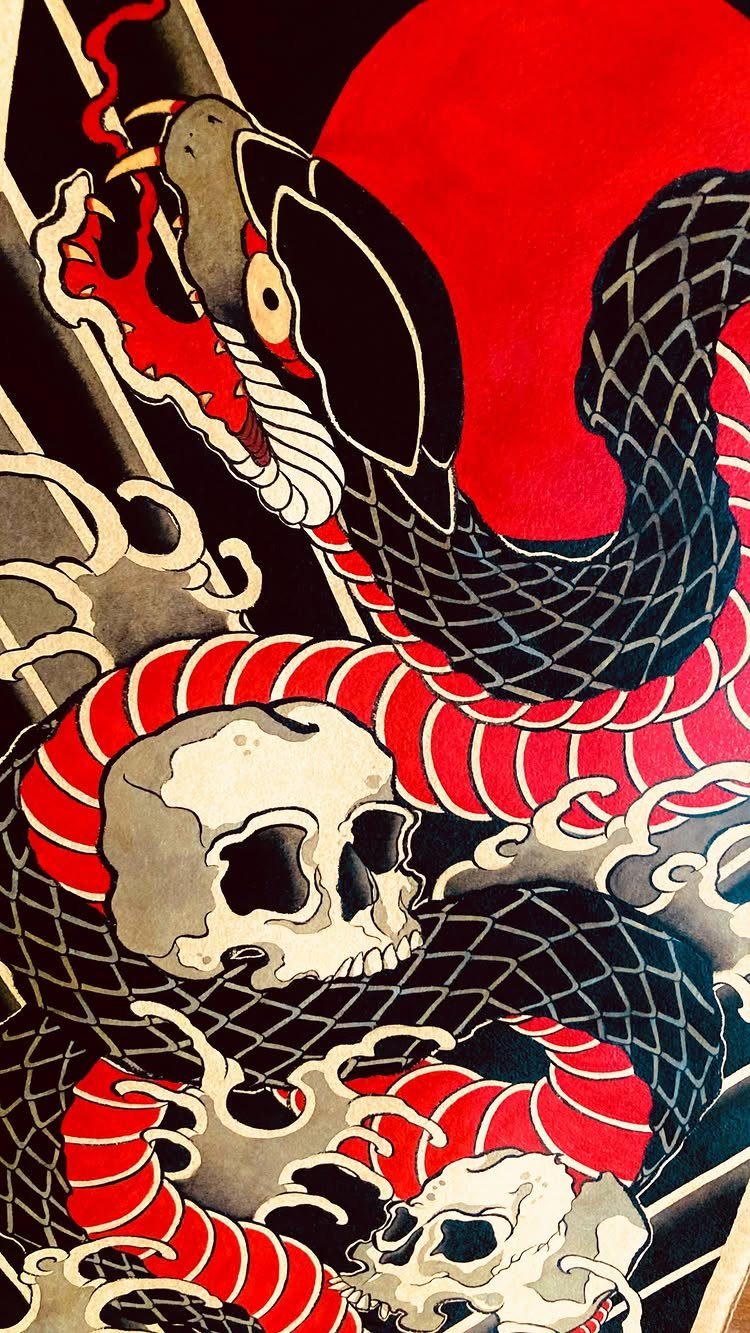
The original piece was made with inks and acrylics on cotton paper, 60 cm by 36 cm, which gives you a sense of the scale this composition wants.
A snake through a skull has meant rebirth, temptation, or protection depending on who is wearing it. Both together, with the snake binding them, pushes the symbolism darker: cycles of death, inevitability, gothic excess.
Red and black is the classic split for serpent skull work.
5. Pirate Skull Tattoo
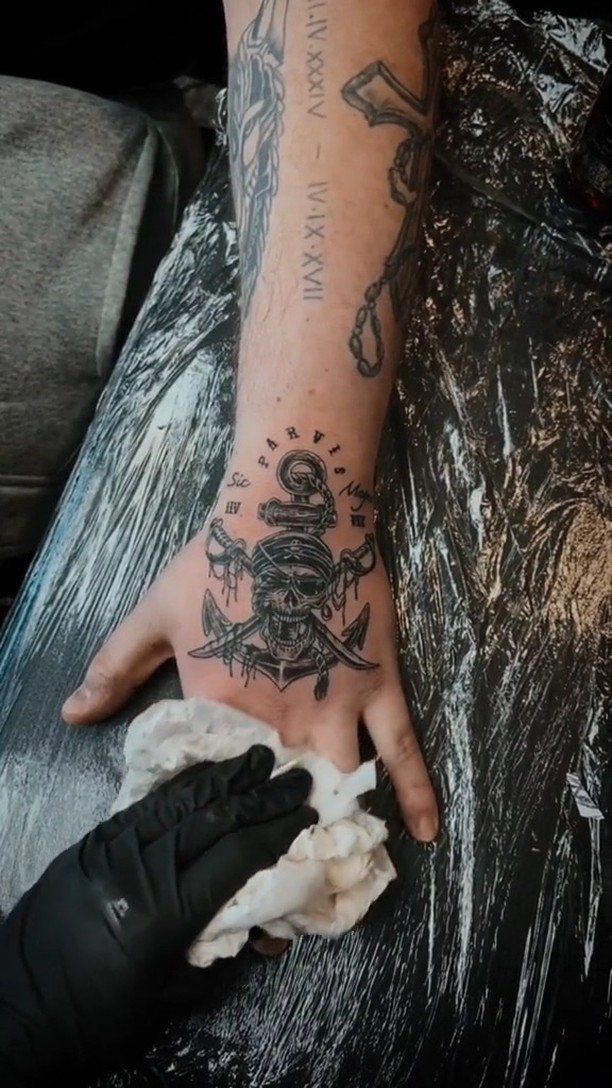
A skull wearing the pirate life: crossed bones, anchor, maybe a bandana or tricorn depending how literal you want to go. This one sits on the hand, which is bold placement for a bold subject.
Hands fade faster than most spots.
Skin there regenerates quickly, and the tattoo takes more sun, more friction, more washing than anywhere else on the body. Budget for touch-ups every few years if you want the lines sharp.
Traditional style suits pirate skulls. Bold outlines, limited shading, high contrast, all built to last through the weathering hands take.
6. Butterfly Skull Tattoo
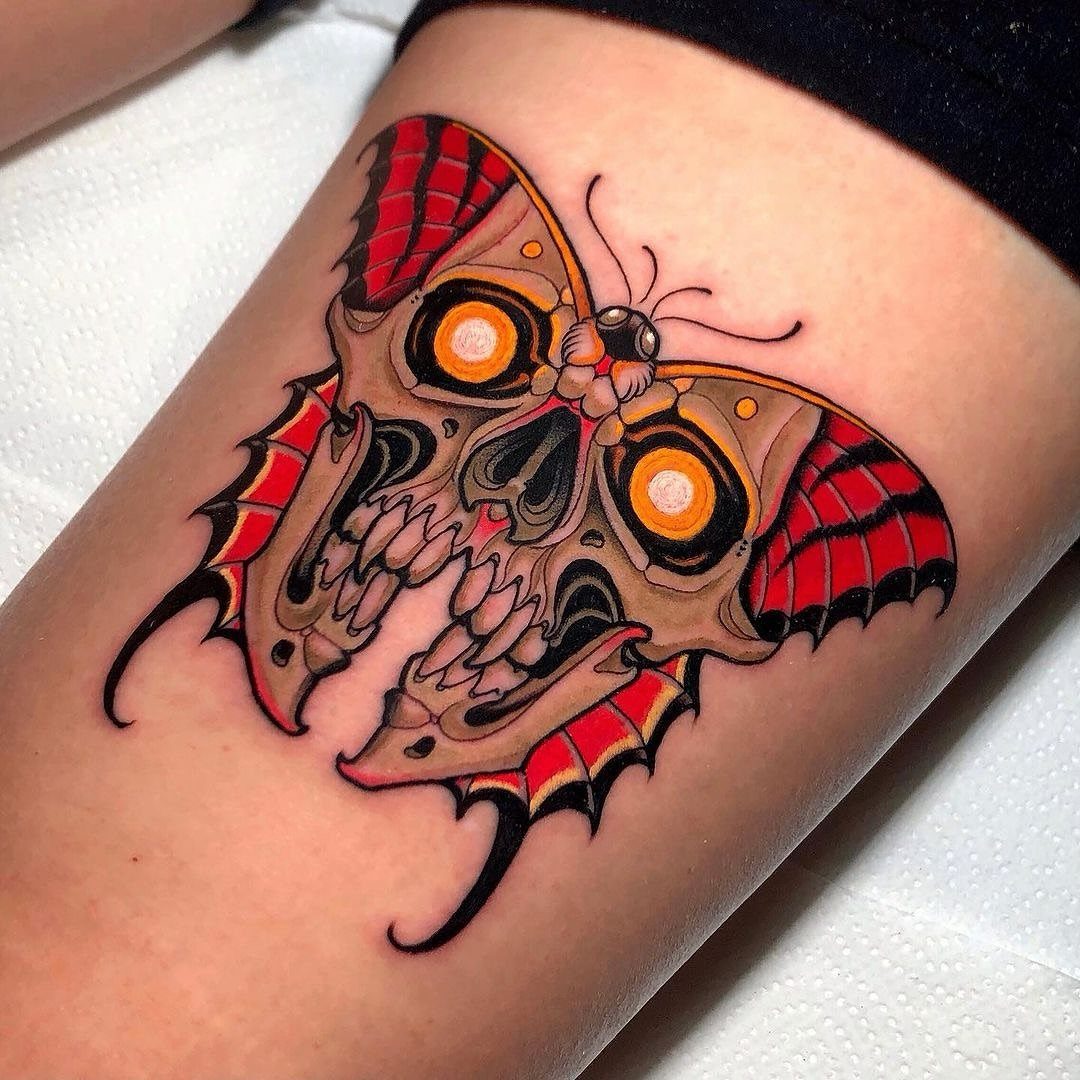
A skull split down the center or merged at the profile with butterfly wings spreading where the temples would be.
The wings glow red and orange, the skull stays shadowed, and the contrast carries the design: death and transformation pressed into one image.
Small versions lose the detail in the wings.
Palm-sized or larger keeps the gradients readable and the skull structure clear. Shoulder blade, forearm, or outer thigh all give you the width the wings need without wrapping awkwardly around a curve.
Color will fade faster than black, so the red and orange will soften while the skull linework holds.
7. Red Skull Tattoo
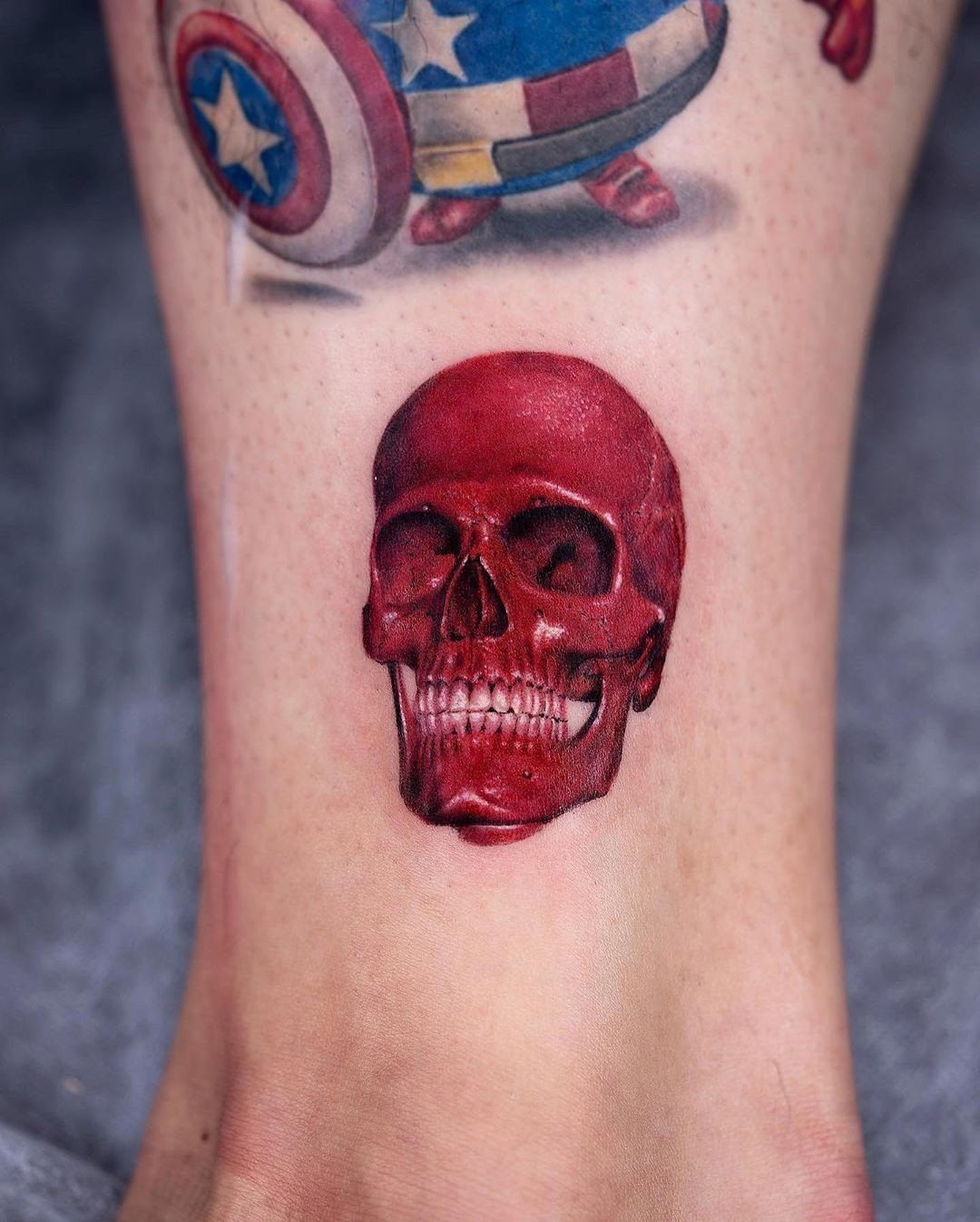
A comic villain inked in red on the ankle, recognizable to anyone who knows the Marvel universe. Red Skull sits opposite the Captain America shield here, which frames the pairing as hero and nemesis.
Ankles are tough spots.
Thin skin, bone close to the surface, and the needle hits nerves that make most other placements feel easy by comparison. The tattoo will also take longer to heal because socks and shoes keep rubbing it.
Small scale works for a character portrait like this. The red keeps it bold without needing much shading.
8. Floral Skull Tattoo
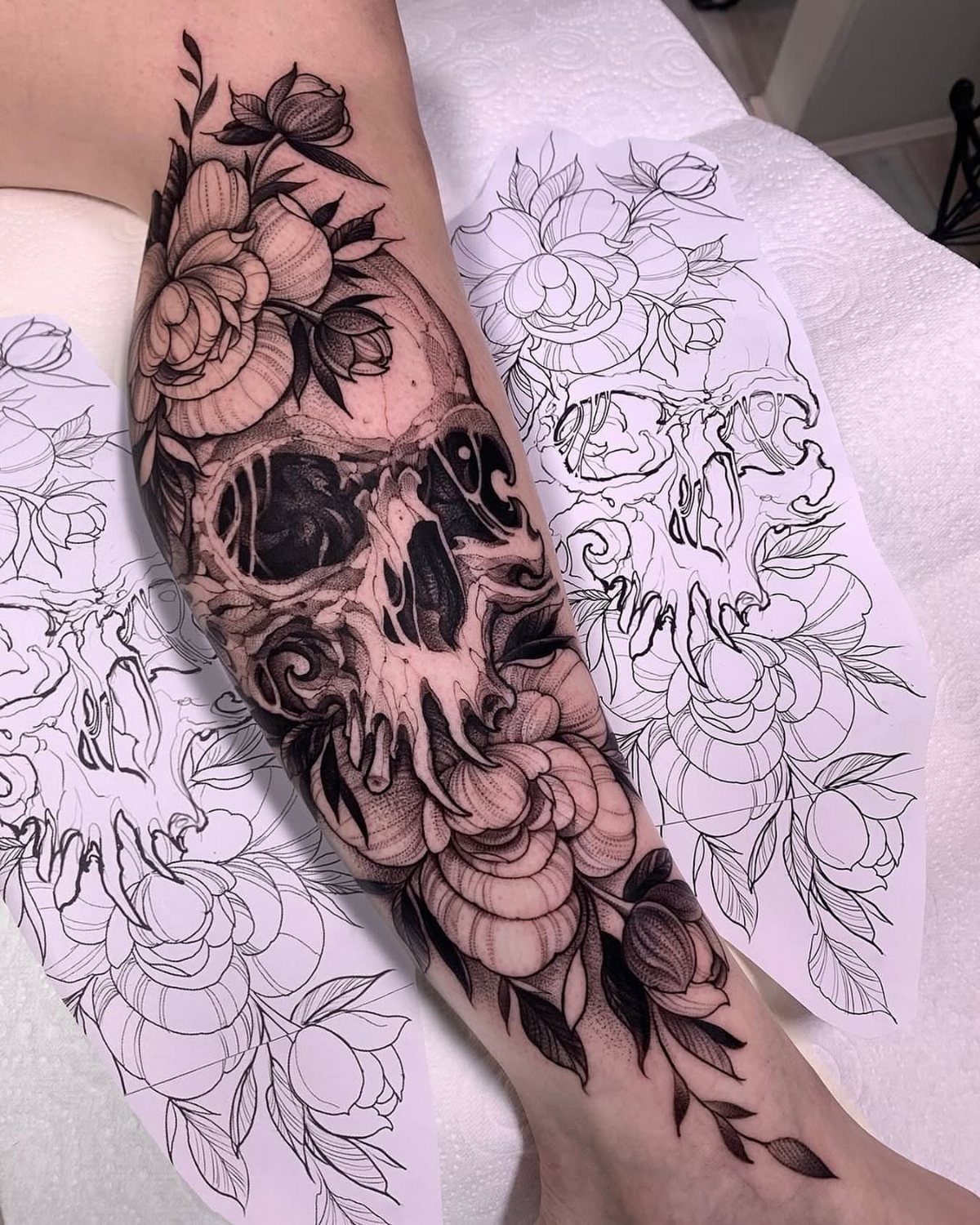
Peonies winding through bone, black and grey keeping both elements in the same register. Floral skull work usually pairs hard edges with soft organic shapes, and the contrast is what makes it read.
Lower leg placement like this one works because the shape of the composition can follow the curve of the calf without forcing the flowers or the skull into awkward angles.
The stencils visible next to it show how much planning goes into fitting the design to the body part.
9. Traditional Skull Tattoo
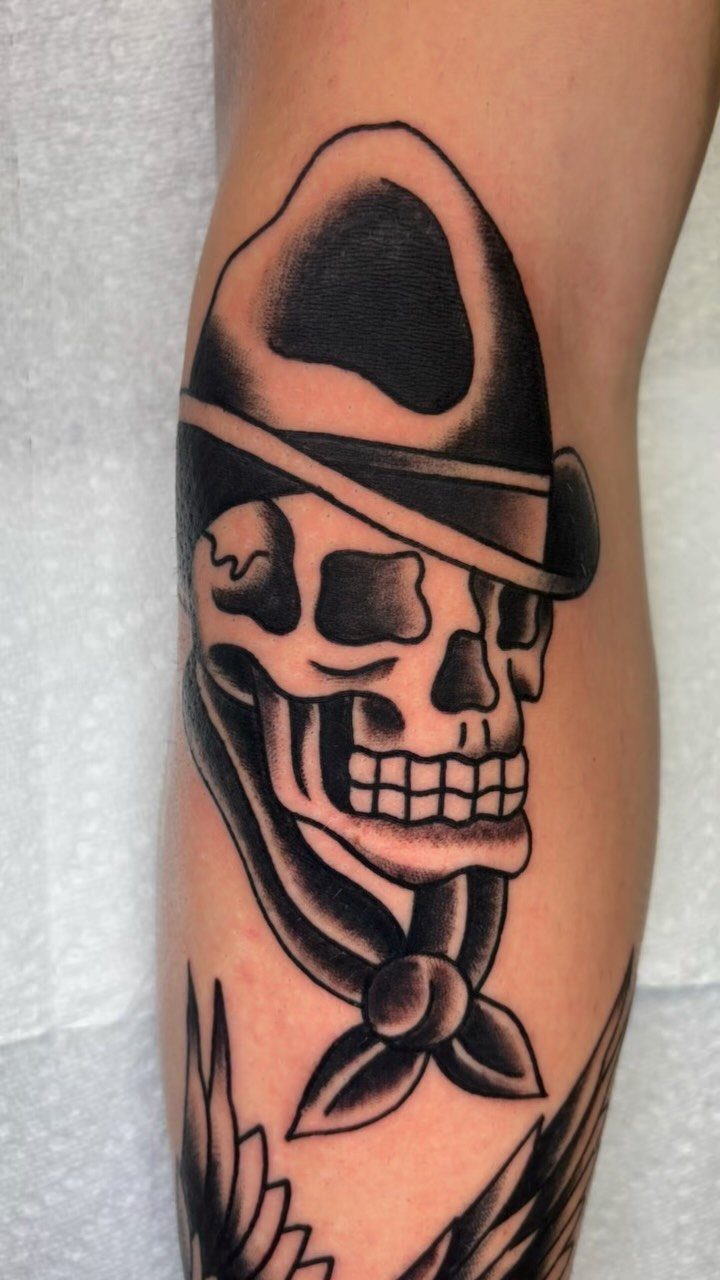
Bold black outlines, minimal shading, a bowler hat adding character without cluttering the skull. Traditional style was built for longevity: thick lines that stay readable as the tattoo ages, high contrast that survives sun exposure and skin changes over decades.
The hat gives this one personality. A bare skull in traditional style can feel generic, but adding one accessory pulls it into a specific mood or era without needing a full scene around it.
Placement anywhere works. Traditional designs hold up small or large because the linework does all the heavy lifting.
10. Celtic Skull Tattoo
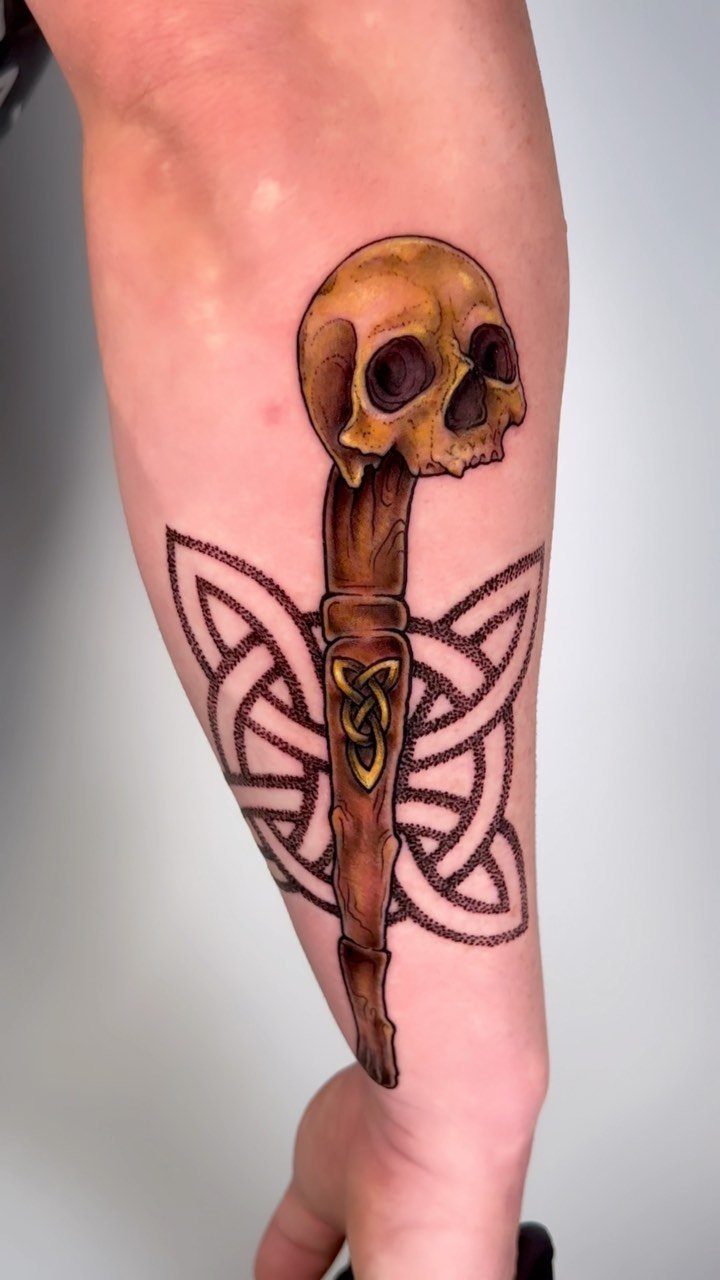
A skull mounted on a staff with Celtic knotwork threading through the background, all rendered in stippled black and grey with a single gold knot as the focal point. The knot represents interconnection, eternity, no beginning or end.
Forearm gives you the vertical space this composition needs. A skull above knotwork reads top to bottom, and trying to fit that onto a rounder body part forces compromises in how the elements stack.
Gold shading on knots tends to muddy after a few years if the artist doesn’t pack enough pigment. Metallic ink fades faster than standard colors, and touch-ups on a single small detail can be tricky to match years later.
11. Octopus Skull Tattoo
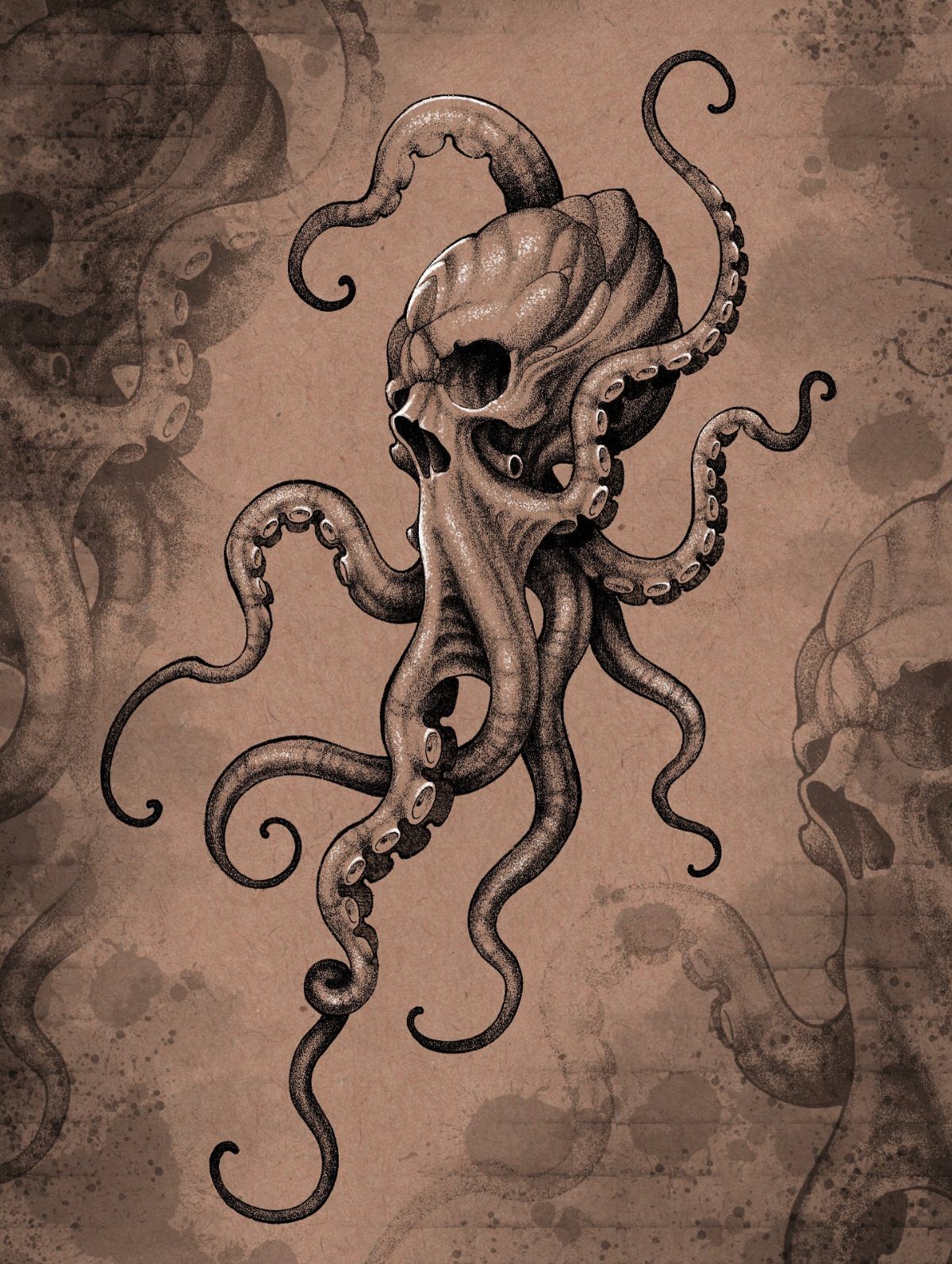
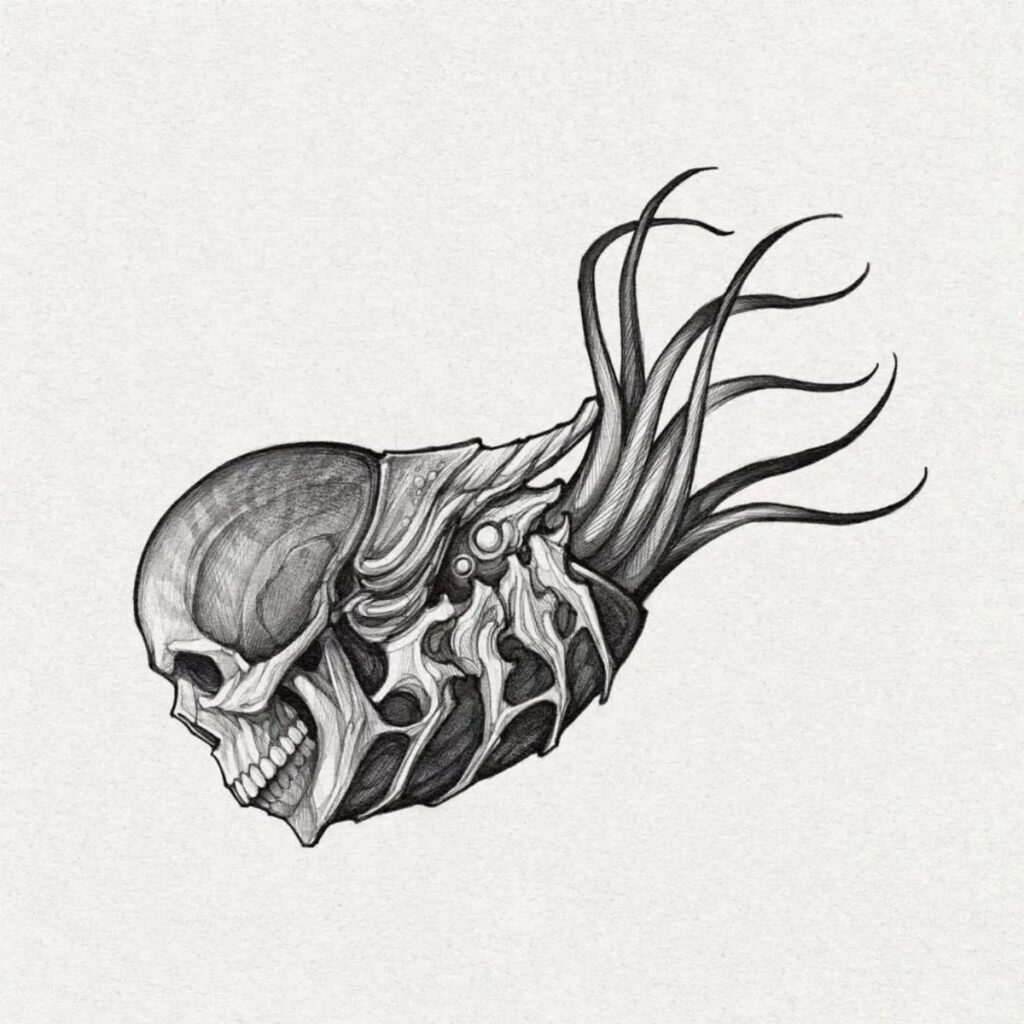
The tentacles need room to coil around the skull or they’ll compress into a tangled shape that loses its logic. Octopus skull designs lean surreal: the creature doesn’t belong inside bone, and that wrongness is the appeal.
This one was illustrated rather than tattooed, which gives you an idea of how it could translate to skin.
The line style here is clean and graphic, which holds up better in a tattoo than heavy shading that can blur as it heals.
A large muscle like the thigh or bicep gives the tentacles space to wrap and spiral without bunching up.
12. Crystal Skull Tattoo
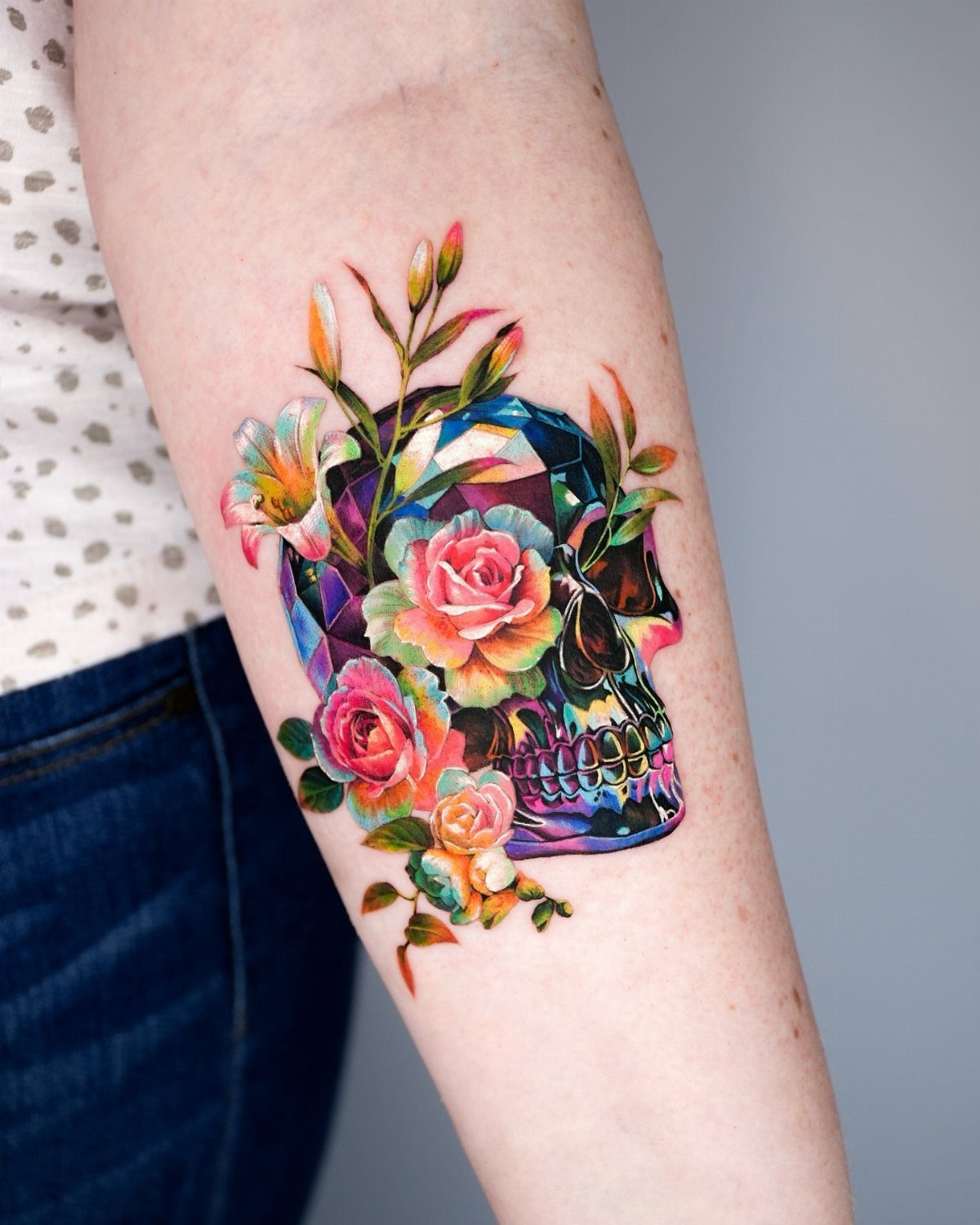
A skull faceted like a gemstone, surrounded by roses and lilies in full color.
The crystal effect comes from geometric shading that catches light the way cut glass does, and it only works if the artist can render those hard angles cleanly.
Color makes this design.
The roses and lilies pull the eye, but the skull’s facets need to stay sharp or the whole thing reads as a regular skull with flowers. That means precise linework and shading that doesn’t soften as the tattoo settles.
Forearm placement puts intricate facets where you and everyone else can actually see them, which is the whole reason to get a crystal skull.
13. Vampire Skull Tattoo
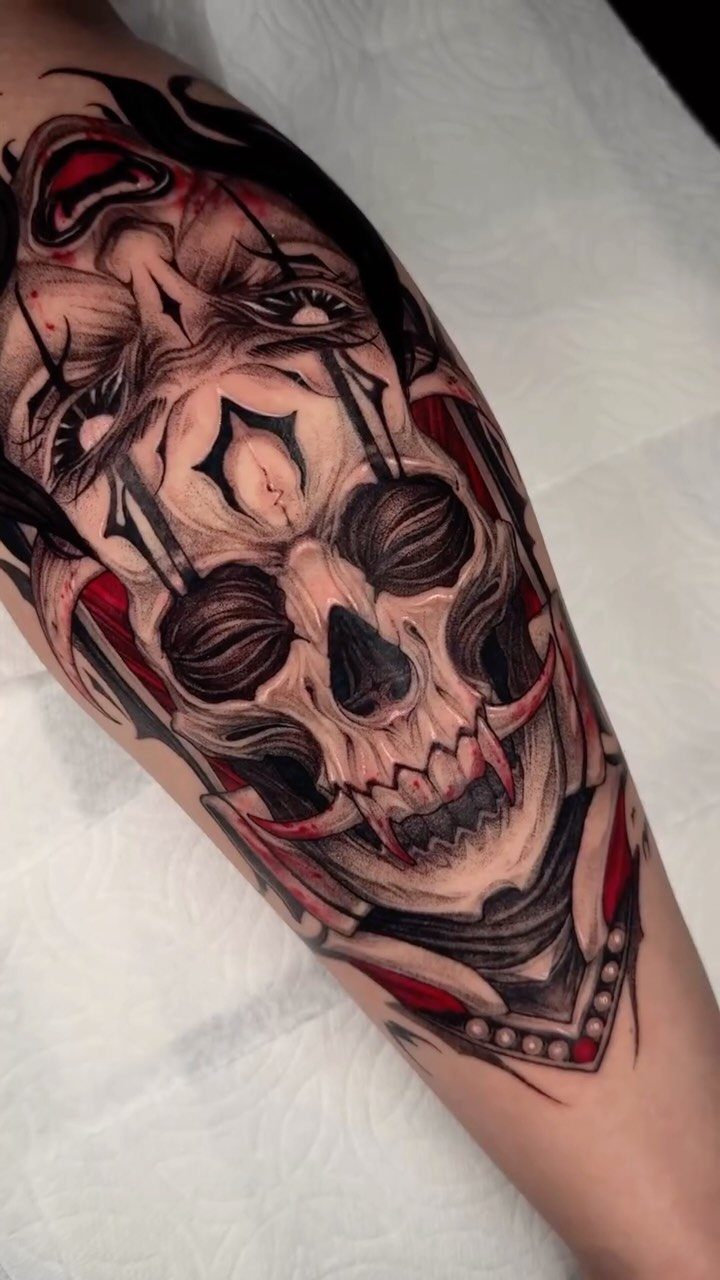
Fangs jutting from the maxilla, turning an ordinary skull into something predatory.
Black and grey keeps it in the horror register without cartoon color. Upper arm gives you space for both the skull and the secondary figure without crowding either one into illegibility.
The fangs need to be long enough to read clearly or the design just looks like a regular skull with small teeth.
14. Skull with Wings Tattoo
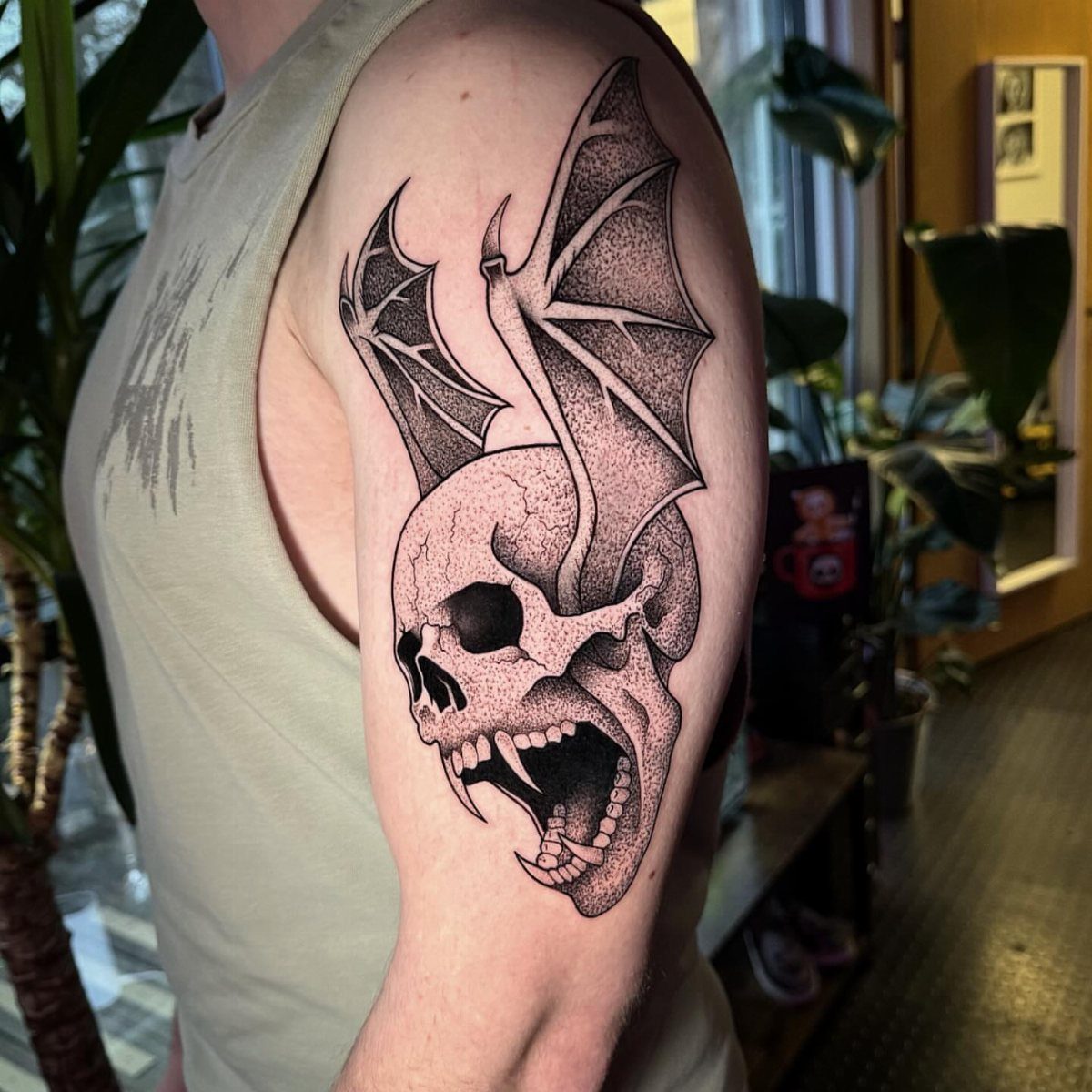
Bat wings stretching from the temples, mouth open mid-scream. Memento mori in visual shorthand: remember you will die, rendered in the anatomy of flight and decay.
Bat wings sit flatter against the skull than bird wings, which makes the composition easier to fit onto a single surface. Bird wings push the design wider and need more wrapping or a larger canvas.
Black and grey holds the gothic mood better than color, and the screaming expression keeps it unsettling rather than decorative.
15. Longhorn Skull Tattoo
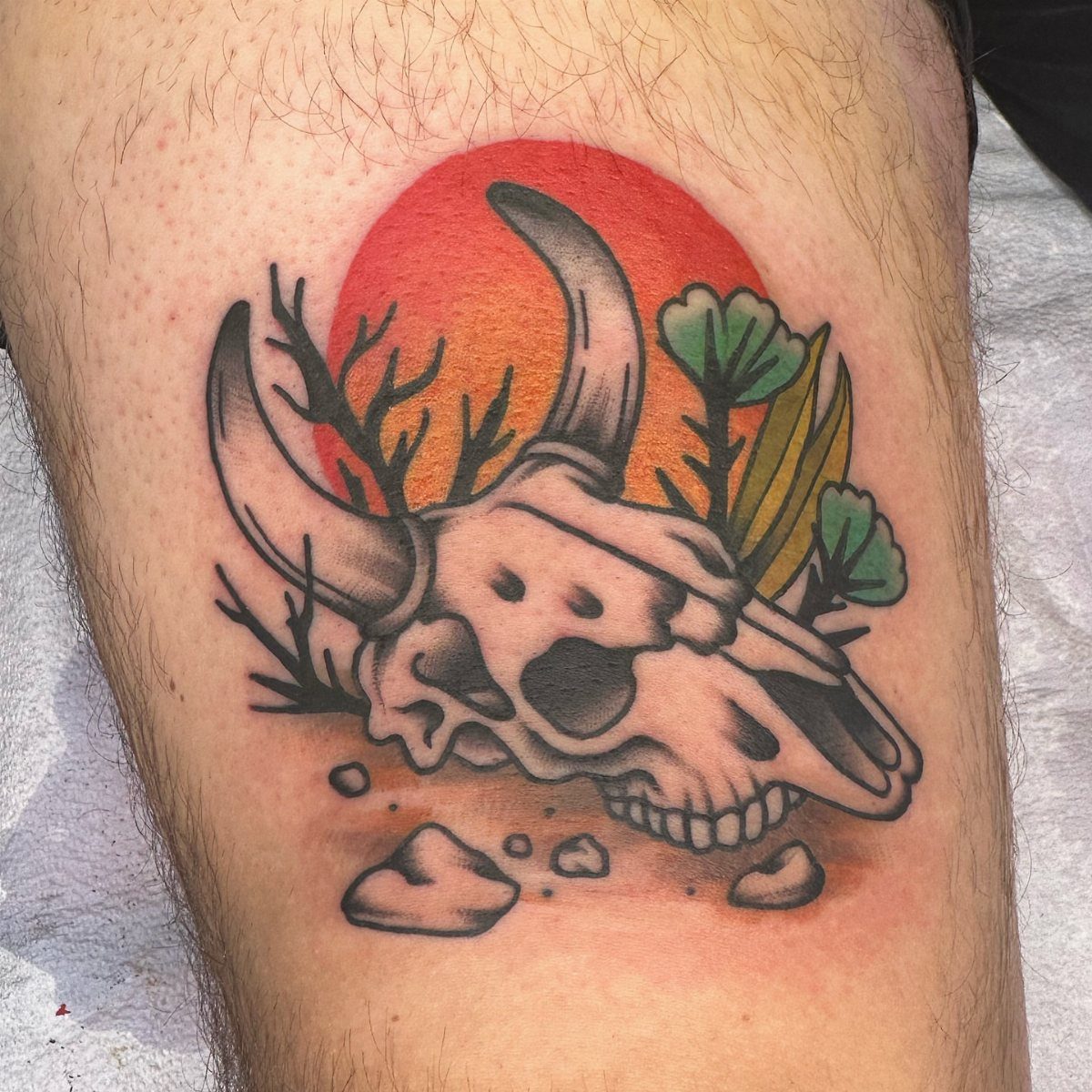
Desert iconography compressed into one image: bleached horn curve, red sun, cactus and sparse plant life filling the space around the skull.
Western and Native American visual traditions both claim this composition, and the red sun is what pulls it into the spiritual side rather than pure ranch aesthetic.
The red needs to stay saturated or it fades into pink and loses the weight it carries against the black linework. Calf placement like this one works because the skull and horns can run vertical without wrapping awkwardly.
16. Bear Skull Tattoo
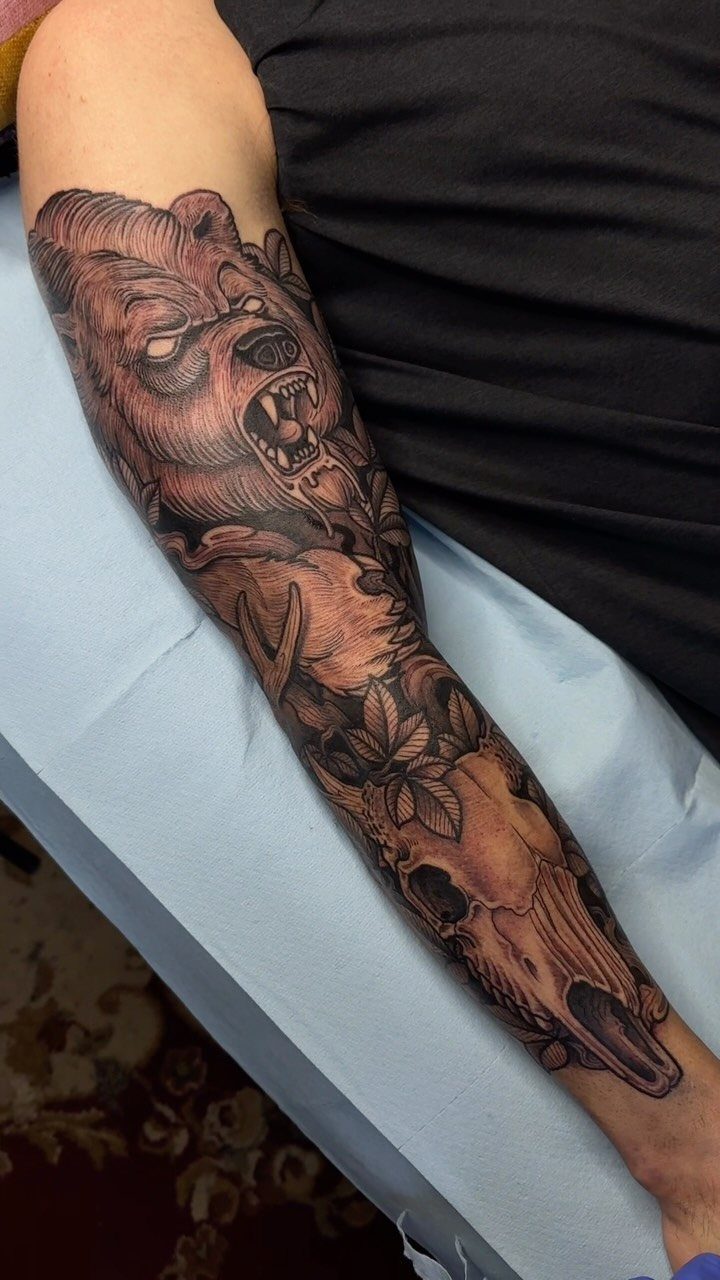
Half roaring bear, half stripped skull, split down the centerline or fading from one to the other. The transition is the design: life and death in the same animal, rendered so the viewer sees both at once.
Forearm gives you the length this needs to read as one continuous image rather than two separate pieces stacked. The leaves soften the composition without pulling it out of the natural world the bear belongs to.
Animal skulls hold more character than human ones because the snout and teeth structure vary so much between species.
17. Surrealistic Skull Tattoo
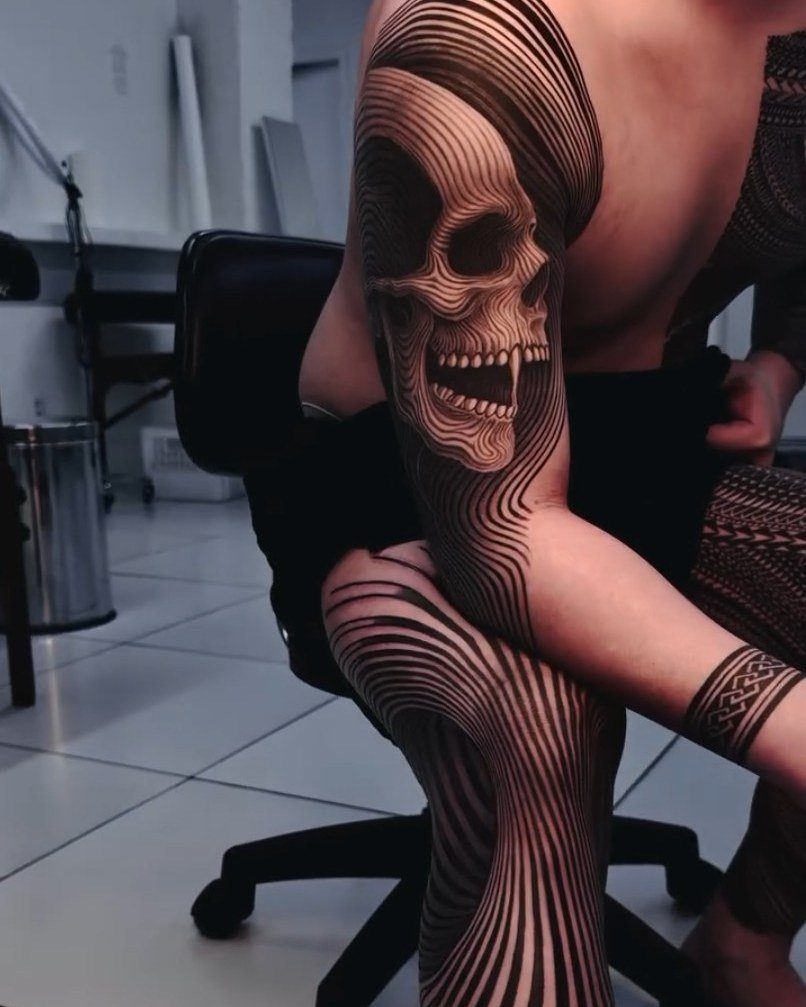
A skull dissolving into flowing linework, reality bending at the edges. Surrealism in tattoo form works when the anatomy stays recognizable enough that the distortion has something solid to distort against.
This one uses only black lines, no shading, which keeps it graphic rather than painterly. Upper arm and forearm together give the composition room to flow without the lines bunching or losing their rhythm where the arm bends.
Linework this fluid depends on the artist’s hand. Small wobbles show.
18. Realistic Skull Tattoo
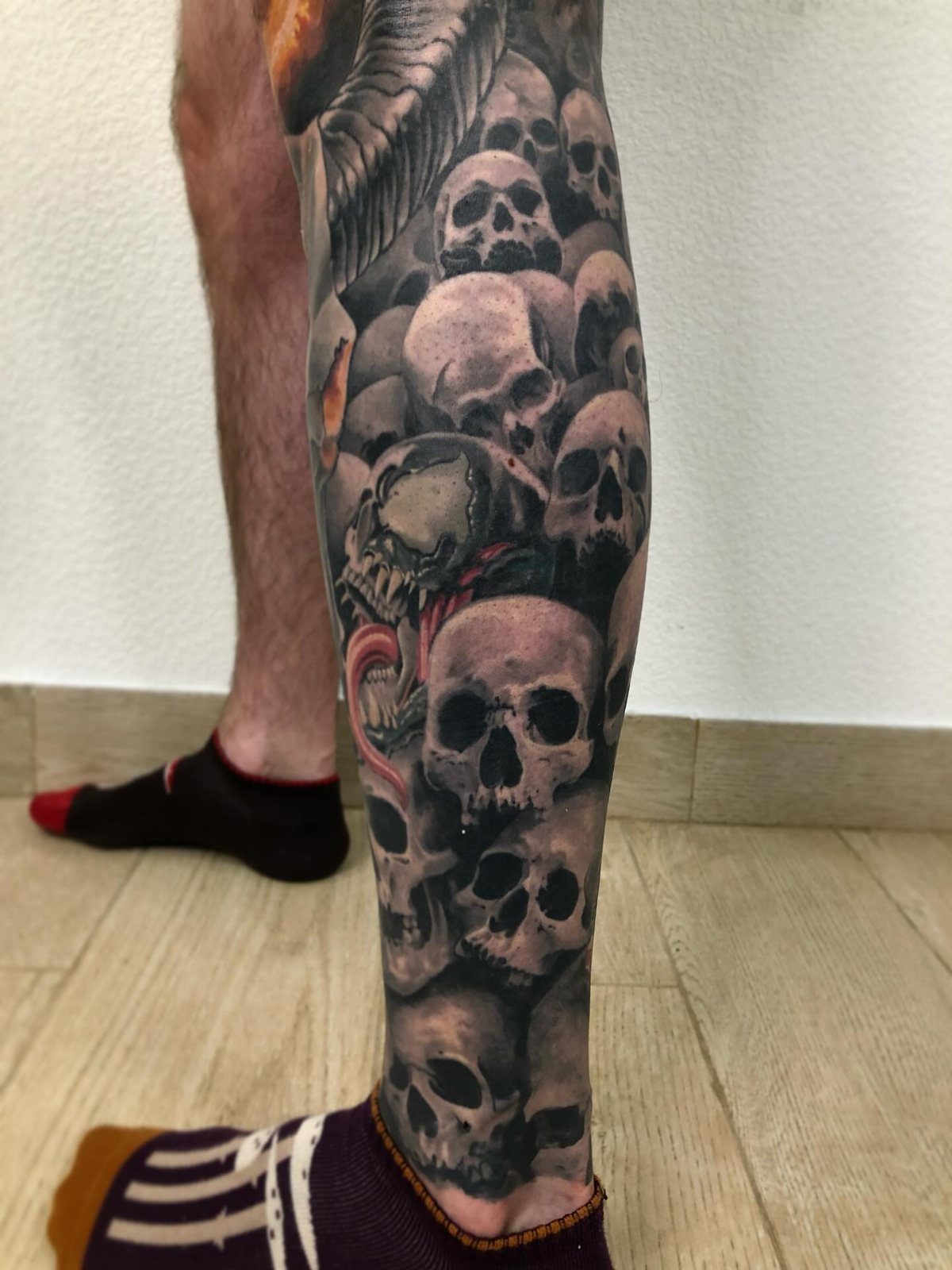
Multiple skulls stacked and overlapping, shaded to look three-dimensional and weathered. Realism in skull work means bone texture, shadow depth, and proportion accurate enough that the anatomy reads true even at a glance.
Lower leg placement like this covers a large area, and realistic tattoos need that space or the detail compresses into mud.
Expect longer sessions because the shading takes time to build correctly, and touch-ups are common as the grey tones settle.
Realism ages differently than bold traditional work. Fine detail softens, so go larger than you think you need.
19. Skull with Watch Tattoo
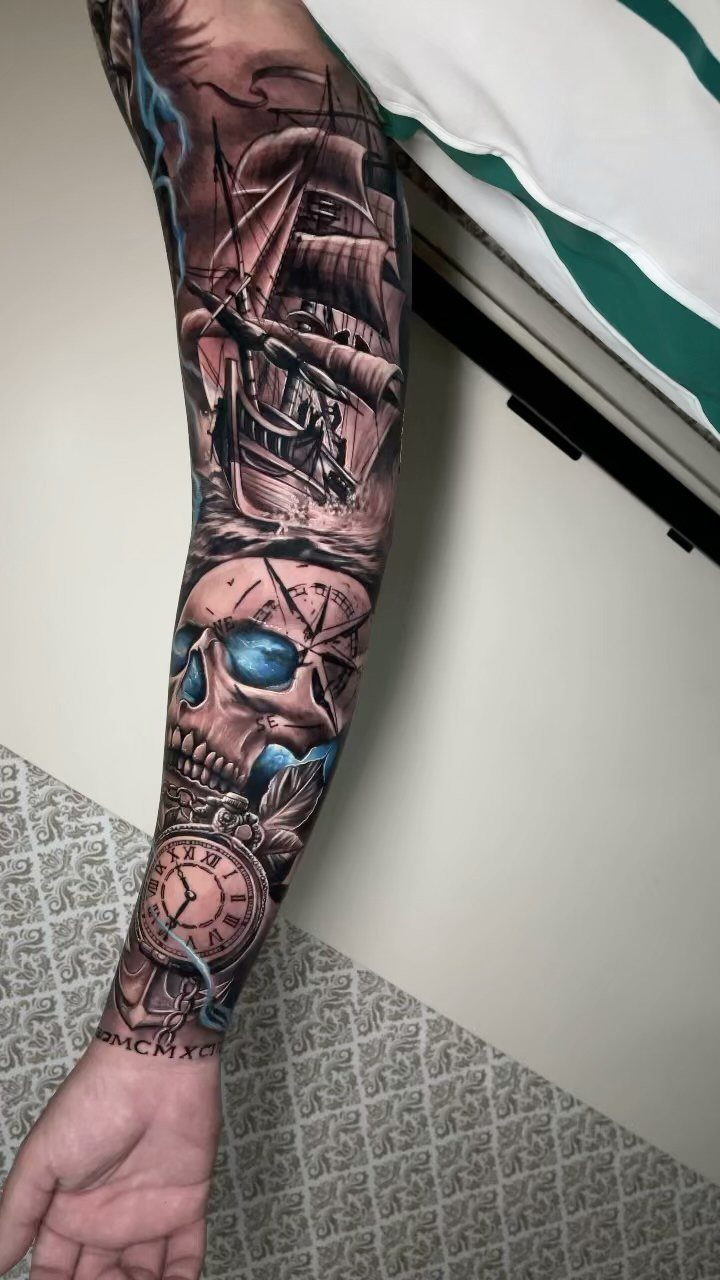
A skull paired with a pocket watch or clock face, mortality measured in hours. The ship and compass in this sleeve add movement and direction, but the watch is what pins the meaning: time runs out.
Roman numerals on a watch are easier to tattoo cleanly than small Arabic numbers. The larger shapes hold up better as the tattoo ages, and they read from farther away.
Full sleeves give you room to layer several symbols without crowding each one into illegibility. A skull and watch alone can fit forearm scale if that’s all you want.
20. Skull Wizard Tattoo
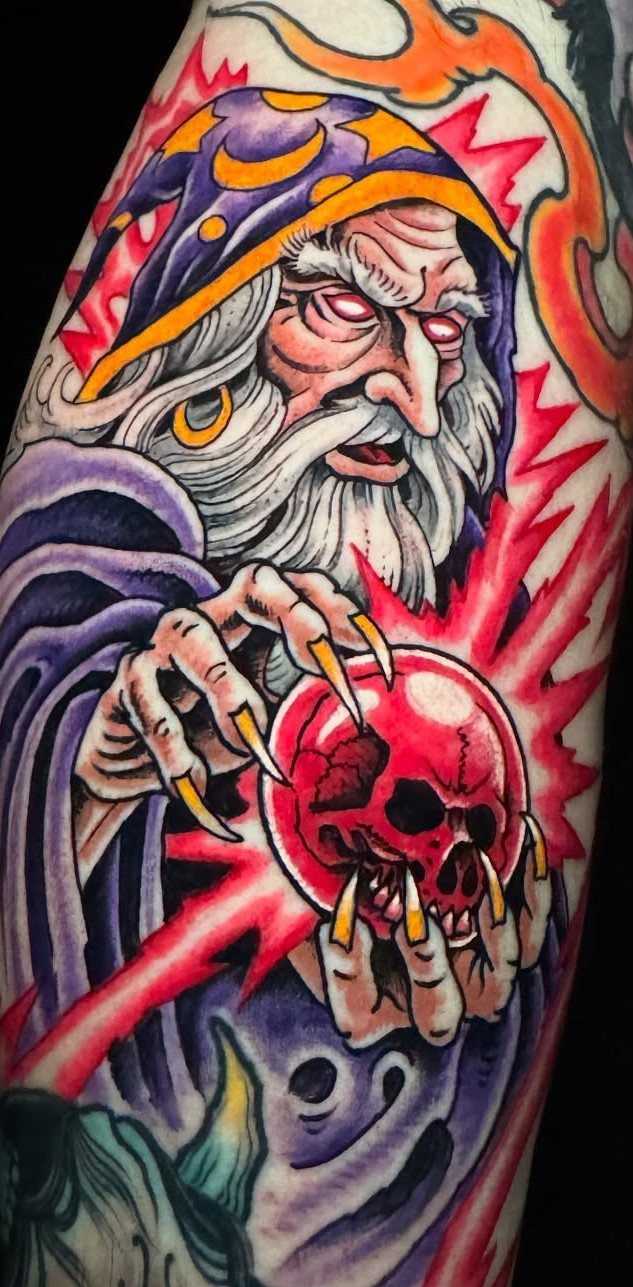
A wizard cradling a skull in a glowing orb, magic and death meeting in one figure. The purple robe and red light give this one a storybook quality rather than pure occult dread.
Color like this needs regular sun protection or it fades unevenly.
Placement with muscle underneath, like the bicep, thigh, or calf, keeps the robes and folds from distorting when you move.
21. Skull with Crown Tattoo
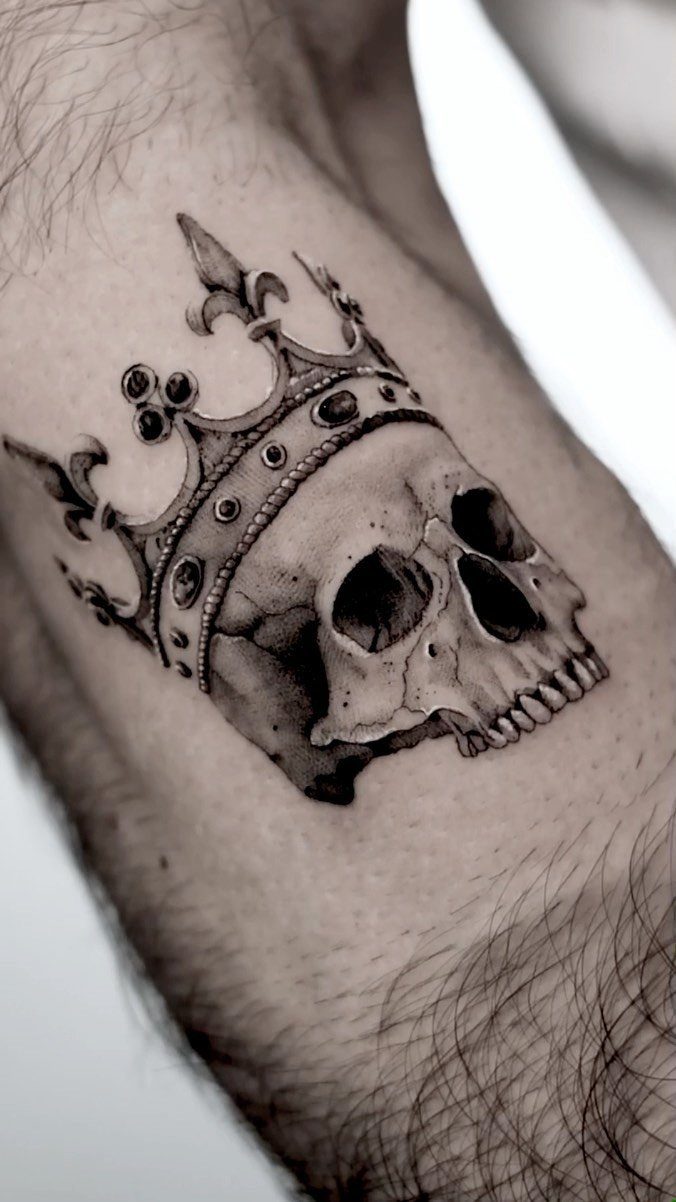
A skull crowned, the imagery borrowed from royalty but twisted: the ruler is dead, the power remains. Black and grey realism suits this because the jewels and metalwork in the crown need fine shading to look dimensional.
Crowns add vertical height, so this composition works best on body parts with length to spare. Upper arm, outer thigh, or calf all give you the space without forcing the crown to wrap awkwardly.
Realism requires touch-ups as the grey tones settle. Fine detail softens over time.
22. Skull and Anchor Tattoo
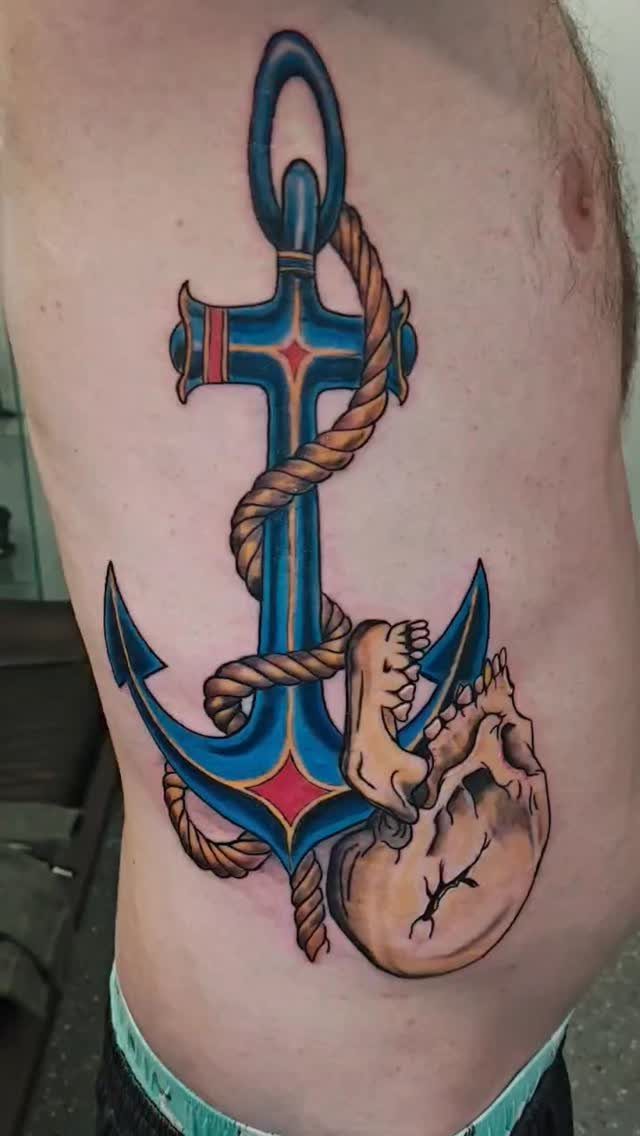
Anchor and skull together, sailor tattoo tradition stripped to 2 symbols. The anchor means stability or hope, the skull means the obvious, and together they nod to the risk sailors carried every time they left port.
Blue ink on the anchor itself is less common than the black or grey most anchor tattoos use, and it keeps this one from looking too severe.
Ribs hurt more than most placements.
Meanings of Skull Tattoos
A skull can mean death, and it can mean the opposite: transformation, rebirth, the idea that what ends makes room for what comes next.
In some traditions the skull holds the soul or what the ancestors knew, and the ink means more than death alone.
There the skull means love, protection and good luck. It is not a scare symbol but a celebration.
Pairing a skull with other objects shifts the meaning.
A skull with roses can mean grateful dead, or love meeting death. The combinations are what let you steer the symbolism toward what you want it to say.
Some people skip the symbolism entirely and get a skull because it looks good. That counts too.
Artistic Styles for Skull Tattoos
Most skull tattoos are done in black and grey. It holds detail well, ages predictably, and keeps the design serious without going cartoonish.
Fine shading softens as the tattoo settles, so realistic skulls need more space than you think to keep the detail readable years out.
3D style adds dimension by shading the skull to look like it is lifting off the skin or receding into it.
This approach works best on flat surfaces like the shoulder blade or outer thigh, where the illusion does not distort when you move.
The bold lines stay crisp through decades of sun and skin changes, which is why sailors favored it.
Cultural Significance of Skull Tattoos
Skulls carry different meanings depending on where the symbolism comes from.
Some cultures see death as a passage rather than an ending, and believe the dead still touch the lives of family left behind. The skull becomes a protective symbol rather than a reminder of loss.
Memorial tattoos often use skulls to honor someone who died. Adding their name, dates, or a personal object they loved turns the skull into a tribute rather than a generic death image.
In Mexican tradition, sugar skulls decorated for Día de los Muertos represent love, protection, and good luck. The bright colors and patterns are not meant to soften death but to celebrate the person being remembered.
Skulls alone can feel gothic or rebellious, but adding a spiritual element changes how people read it.