Fish skeleton tattoos range from koi that keeps its color and curves even as bone to anglerfish skulls where the teeth and lure remain recognizable, plus tribal designs that hold their shape in solid black and fine-lined versions where every rib shows.
The choice comes down to line weight and how much skeletal detail survives: tribal silhouettes in bold black stay readable as the tattoo settles, koi skeletons preserve the fish’s shape while showing bone structure, and fine-lined ribs capture fragility but need more care over time.
1. Koi Fish Skeleton
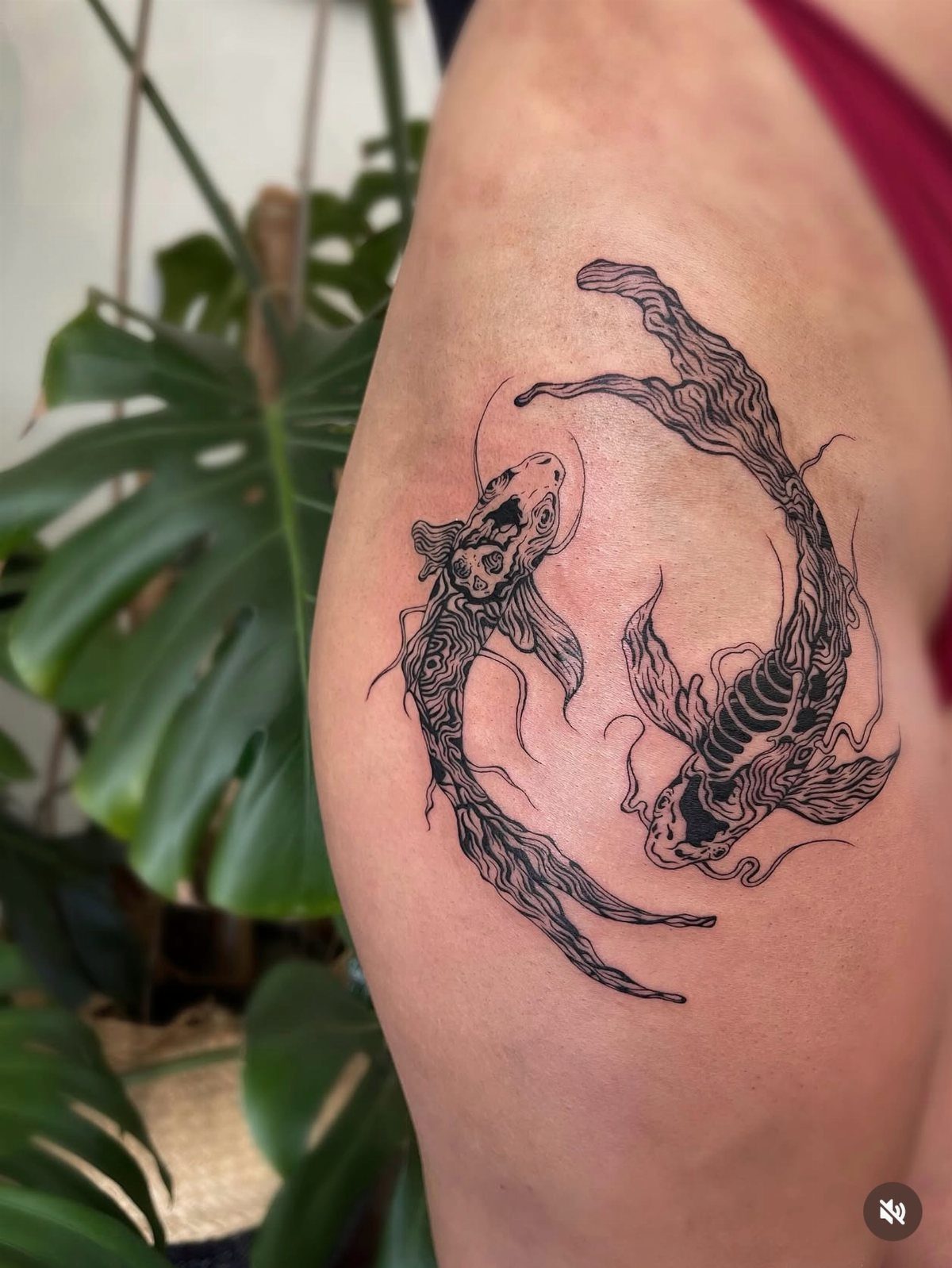
2 koi skeletons circling each other, rendered in black ink with exposed ribs and vertebrae intact. The design works on curved surfaces like the thigh or shoulder blade, where the fish can follow the body’s natural lines.
Koi bones are delicate, so the linework needs to stay bold enough to read as the tattoo ages. I’d keep each fish large enough to preserve the skeletal detail without the ribs bleeding together over time.
The circling composition suggests balance and duality without needing color or shading to carry the concept.
2. Anglerfish Skeleton
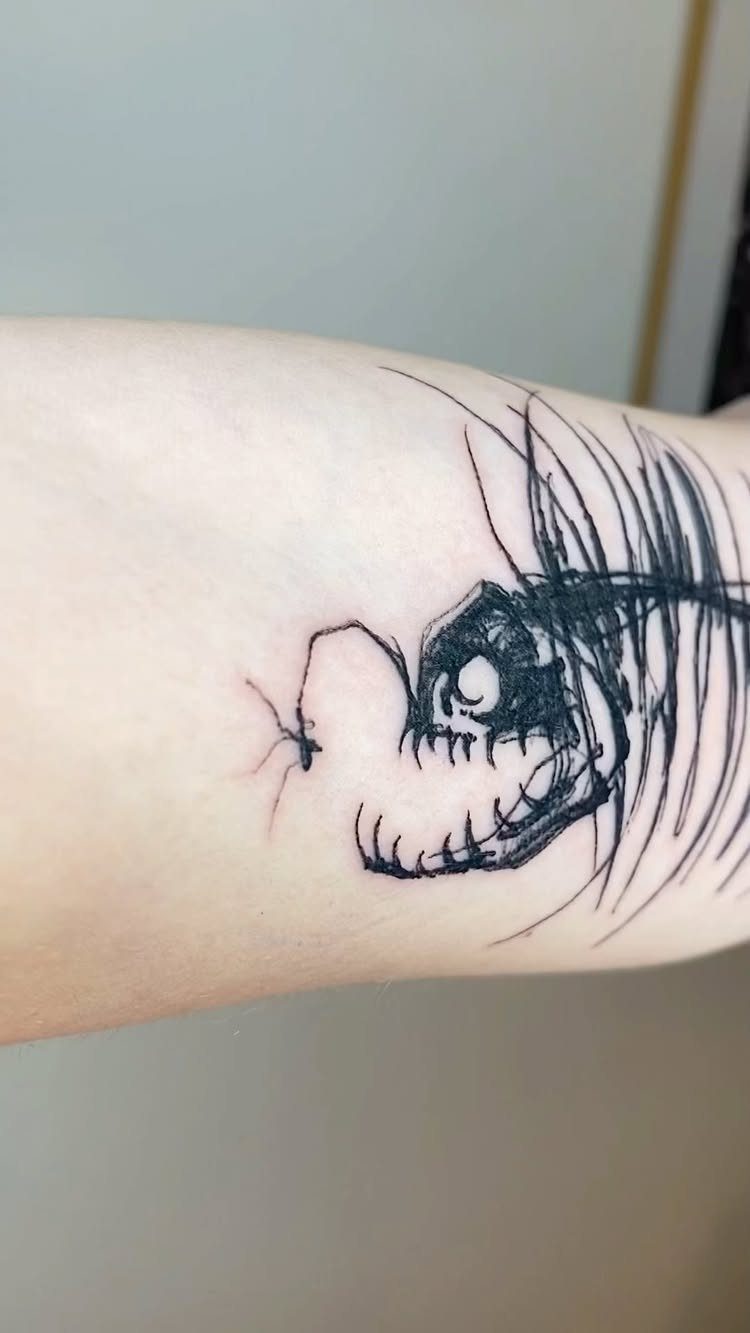
An anglerfish skeleton keeps the species’ signature teeth and bioluminescent lure, both still recognizable even when stripped to bone. The teeth stay sharp and prominent, the lure extends from the skull, and the skeletal structure shows the fish’s exaggerated jaw.
This one reads best in black ink on the forearm, where the length of the fish can stretch along the limb. The teeth and lure make it immediately identifiable, so you avoid the generic fish skeleton look.
Size matters here. Below a certain size, the teeth start to blur together.
3. Fish Skeleton with Fine-lined Fins
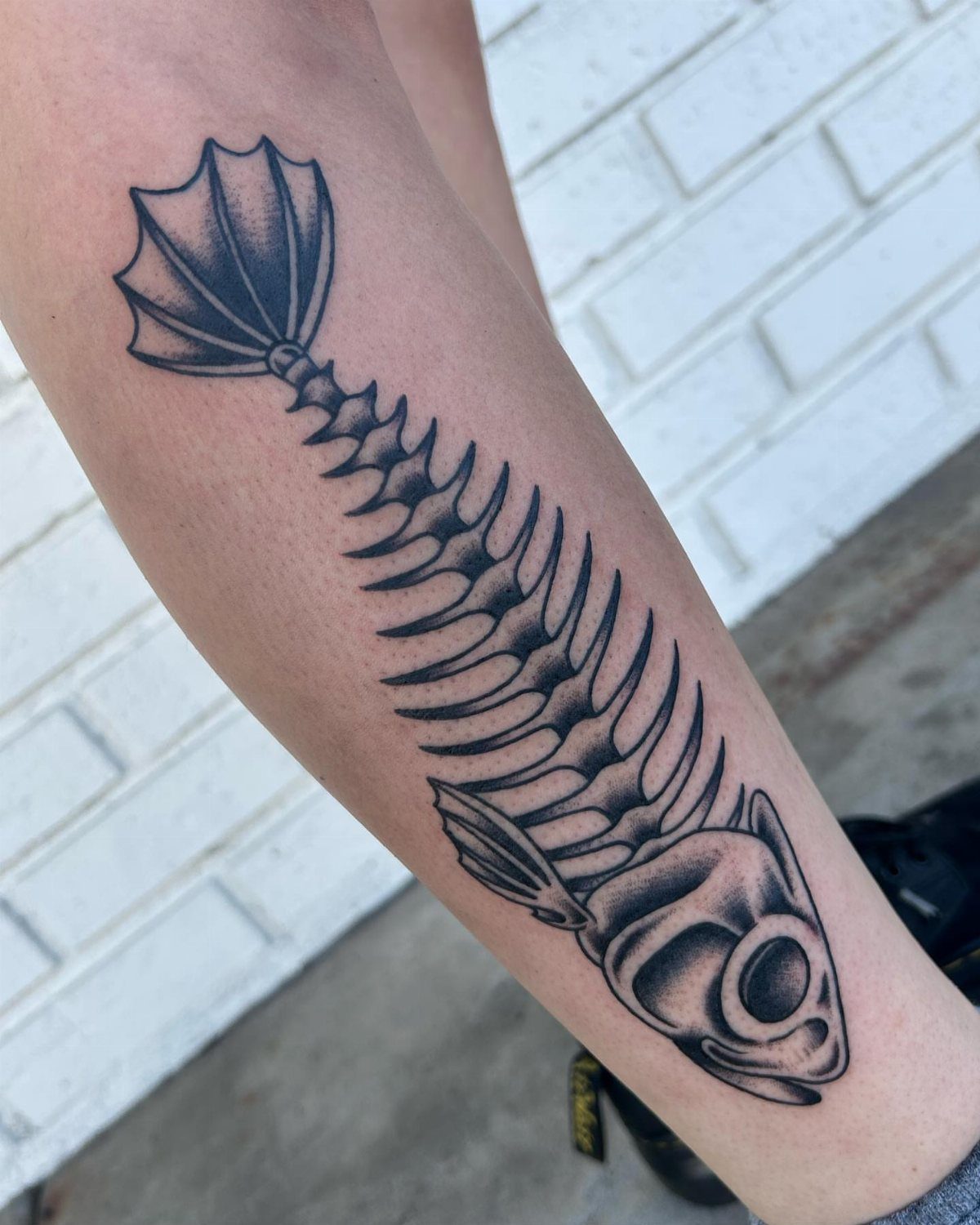
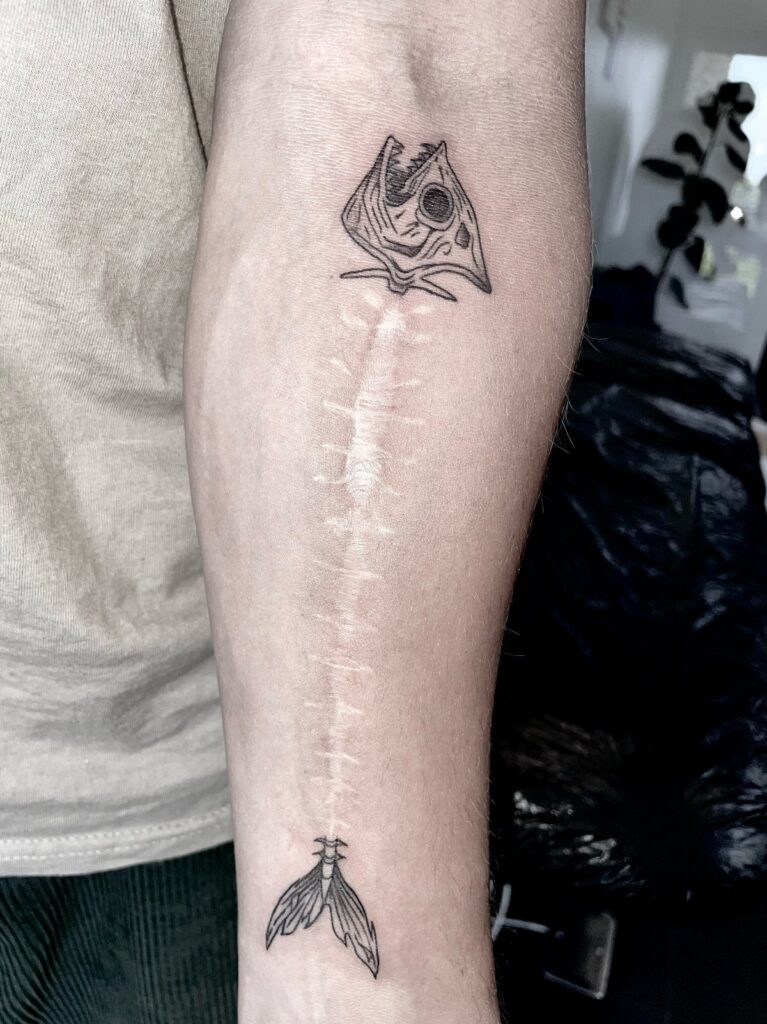
A fish skeleton with fine-lined fins keeps the delicate, almost feathered look of the fin rays while the body stays skeletal.
The contrast between the sharp, precise lines of the fins and the heavier bone structure of the spine and ribs gives the design texture without adding shading.
This approach works well on the forearm, where the vertical space lets the fins spread without crowding.
The fine lines require a steady hand and will fade faster than the bolder skeletal elements, so expect the fins to soften first during healing and over the years.
4. Tribal Fish Skeleton Tattoo
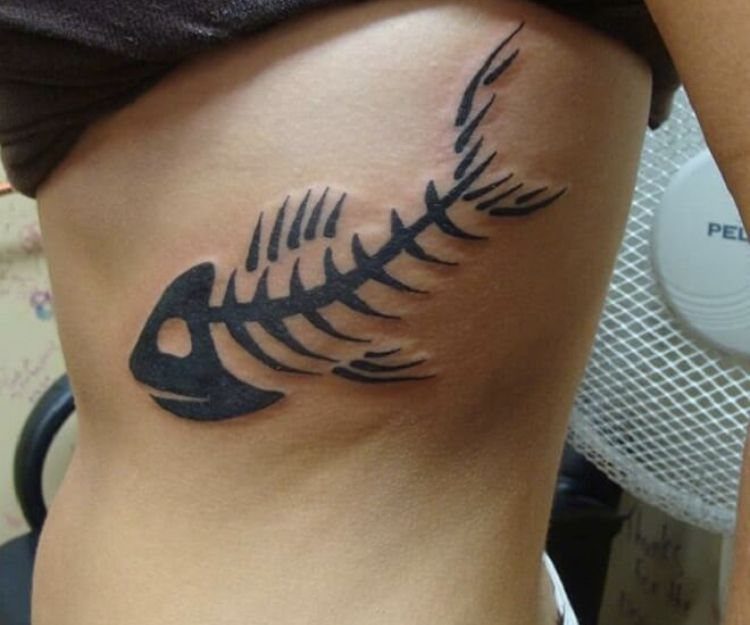
A tribal fish skeleton replaces realistic bone detail with bold black shapes and negative space. The ribs become geometric bands, the spine simplifies into a continuous curve, and the whole design reads as a silhouette rather than an anatomical study.
Tribal style suits placements with natural curves, like the ribs or outer thigh, where the solid black can wrap and flow.
You lose some clarity: tribal abstracts the fish skeleton enough that someone unfamiliar with the style might not immediately recognize it as a fish.
This style ages well. Solid black holds longer than fine linework.
5. Fish Morphing Into a Skeleton with Waves
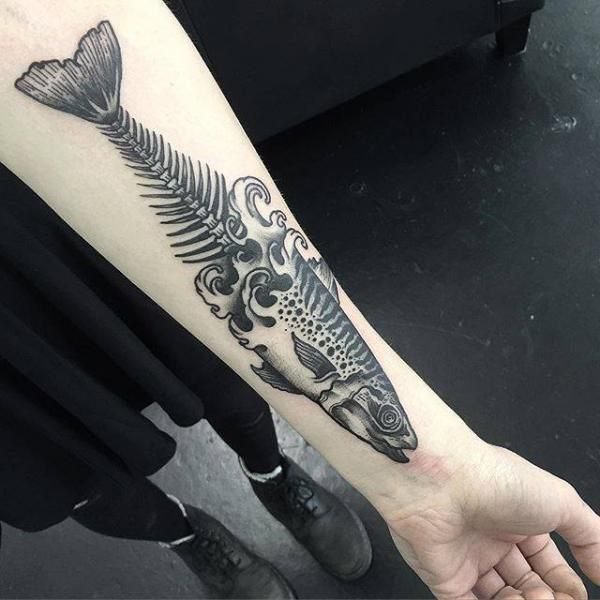
A fish morphing into a skeleton shows the transition from flesh to bone, usually split down the center or fading from head to tail. The visible example pairs it with waves, grounding the design in water and adding movement.
The morph concept needs length to work, so the forearm or outer calf gives enough space for the transition to read clearly. The waves can sit behind the fish or wrap around it, depending on how much coverage you want.
This design tells a story without text, which makes it easier to read from a distance than a skeleton alone.
Symbolism of Fish Skeleton Tattoos
Fish skeleton tattoos sit at the intersection of mortality and structure. Where a full fish reads as life and movement, the skeleton strips that away and leaves only the architecture beneath.
The symbolism shifts depending on how you read it.
Some see transformation, the idea that what remains after death still holds form and purpose. Others lean into the memento mori angle, a reminder that everything living ends up reduced to bone.
Fish bones are finer and more delicate than the skeletons of land animals, which gives them a different visual rhythm.
The ribs curve in tight, regular intervals, the spine tapers to almost nothing at the tail, and the skull stays small and pointed.
That fragility becomes part of the design’s appeal, though it also demands bolder linework than you’d expect to keep the detail readable as the tattoo ages.
Placement Ideas for Tattoos
Fish skeletons need length, so vertical and diagonal placements give them room to stretch without compressing the ribs or losing the taper of the spine.
The forearm is the most common spot. The fish can run from wrist to elbow, following the natural line of the arm, and the placement keeps it visible without requiring a mirror.
Outer calf works the same way, with enough vertical space for a full skeleton and the option to extend into waves or background elements when you need more coverage.
Ribs and back let a fish skeleton curve with the body.
A design placed along the ribcage can follow the bones beneath, which adds a subtle echo between the tattoo and your own skeleton. The back offers more width, so you can fit multiple fish or add surrounding elements without crowding.
Thigh and shoulder blade both handle curved compositions well, though the shoulder blade is harder to see on yourself.
Styles of Fish Skeleton Tattoos
Black ink dominates fish skeleton tattoos. The design relies on contrast between the bone and the skin, and black linework gives the sharpest read.
Fine-lined styles emphasize the delicate structure of the ribs and vertebrae, but they fade faster than bold linework and require touch-ups to stay legible.
The design ages better than fine linework, but you lose some of the skeletal detail that makes the fish recognizable up close.
The ribs stay thick enough to read clearly, and the design doesn’t rely on fine gradients that blur as the tattoo settles.